

Meredith Angwin wrote the book on how electric grids get quietly hollowed out. She says it’s happening in the Hudson Valley. She’ll be in Ulster County on August 20.
The latest reliability report from the non-profit electric grid managers at the New York Independent System Operator should be setting off alarm bells in the Hudson Valley. It recommends against the closure of an ancient, bankrupt power plant in Newburgh as scheduled on August 1. In fact, much of the report hinges on the status of the Danskammer power plant.
This is not a secret fossil-fuel conspiracy. It is a matter of life and death for Hudson Valley residents during the next heat wave or cold snap. If the Danskammer plant and its four turbines, the oldest dating to 1951, retired as planned, the region (and the state) would risk devastating blackouts.
What does a rational, win-win energy plan look like for the Hudson Valley? Join us on August 20 at the Hurley Reformed Church to be part of the conversation with Meredith Angwin. Register now.

The plant is staying open until at least January 2027, and it begs another question.
Central Hudson is the electric utility that covers the area around Danskammer; in fact, it built Danskammer over 75 years ago. According to our analysis of Energy Information Administration filings, since 2019, average Central Hudson bills have gone up around 72%, the 5th-highest rate in the country, alongside other New York utilities.

Central Hudson’s service territory has also led the state in climate act staples like rooftop solar adoption and heat pumps.
So if the Hudson Valley is paying more than ever, is leading the state in the energy transition, but is on the verge of running out of electricity, and the plant holding it all together is bankrupt, then what exactly is going on?
Meredith Angwin and “The Fatal Trifecta”
Meredith Angwin, known as “The Electric Grandma” and author of Shorting the Grid, has a theory about why America’s electric grids are failing. She calls it “The Fatal Trifecta.”
The three elements of the Fatal Trifecta are:
- Over-reliance on renewables
- Over-reliance on natural gas
- Over-reliance on imports from neighbors
As a matter of policy, New York has doubled down on the Fatal Trifecta ever since the passage of the 2019 Climate Leadership and Community Protection Act, and the subsequent closure of Indian Point.
Within the state, no region has been as much of a test of these policies as the Hudson Valley.
Over-Reliance on Renewables
The first leg of the Fatal Trifecta is an over-reliance on renewables.
Few regions in the country have invested more in rooftop and community solar than the Hudson Valley. According to our national analysis of Energy Information Administration filings, Central Hudson’s service area has had the 7th fastest solar buildout of any utility in the nation.

It’s not just speed. The Hudson Valley’s installed solar capacity is 12th in the nation:

In a devastating combination, Central Hudson customers’ heat pump adoption is the highest of any utility territory in New York; two and a half times Con Edison’s rate, six times National Grid’s. That means that the region is moving to electric heat precisely when we’re also becoming more reliant on solar energy, which doesn’t work nearly as well in the winter.

Will these trends continue? If Central Hudson’s rate cases are any indication, they are going to accelerate.
The state Department of Service (DPS) staff testified that Central Hudson’s recent climate project suite costing $204 million would provide ‘roughly 664 MW of increased [renewable] headroom benefit.”
Central Hudson’s own customer brochure puts a number on it: climate law-related projects add “approximately $36.6 million per year on electric rates,” or roughly $10 a month averaged across the company’s 310,000 electric customers.
And in the rate case itself, the Department of Public Service’s Staff went further. Strip the CLCPA Phase 1 projects out of Central Hudson’s proposal, Staff wrote in its initial brief, and the company’s remaining capital forecast “would be well below the Company’s historic actual spending levels,” below even the levels the Commission had already approved in the 2021 rate order. (Cases 23-E-0418/23-G-0419, DPS Staff Initial Brief, p. 106.)
So by the state’s own analysis, the entire growth in the capital program driving these delivery increases is the climate program. The Commission’s July 2024 order then set rates on exactly that record.
Then add the CLCPA program mandate money, all of it collected through bills: $191 million in solar incentives for Central Hudson’s territory since the program began, $65 million for heat pumps, and $21 million for EV charging. Over a quarter-billion extra dollars on top of regular rate increases, to push more renewables and demand onto the grid.
And in a region heavily affected by aging infrastructure and brownouts, a 2023 Central Hudson rate case ask for $8M in Electric Transmission Structure Coating was blocked by DPS staff, specifically because the state was prioritizing renewable growth over maintenance programs.
The region has had the 7th fastest solar buildout, it’s 5th in the nation in bill increases, and it’s deferring maintenance to build renewable infrastructure.
Over-Reliance on Just-in-Time Natural Gas
The second leg of the Fatal Trifecta is an over-reliance on “just-in-time” natural gas; i.e., gas that cannot be stored ahead of time for use.
When Indian Point Nuclear Power Plant fully closed in 2021, the replacement was natural gas plants in the Hudson Valley. This led to many headlines about the closure of Indian Point massively increasing CO2 emissions.
Indian Point’s 2,000 carbon-free megawatts were replaced by natural gas: 1,100 megawatts at Cricket Valley Energy Center in Dover, and 680 megawatts at CPV Valley Energy Center in Wawayanda. Despite the Hudson Valley quadrupling its solar capacity, these plants are actually on pace to be relied on more than ever.

Not only are the plants projected to be needed more than ever, the fuel that they run on isn’t guaranteed. Every winter, plant owners tell NYISO how much of their capacity is backed by firm fuel; supply that’s actually arranged, not hoped for.
According to data NYISO presented to the state’s reliability council in February, 89% of Long Island’s gas and oil-fired capacity has firm fuel arrangements for this winter; a guaranteed gas contract or backup fuel stored on site. New York City came in at 82%, and the Capital Region, the only upstate zone measured, at 80%. The Hudson Valley capacity region came in at 67%, last among every region the state examined.
The gap is 1.6 gigawatts of gas capacity with no guaranteed fuel, and it is almost exactly the size of the region’s two gas-only plants. Cricket Valley, the Hudson Valley’s largest generator at 1,100 megawatts, keeps no backup fuel on site, and neither does Danskammer. Every megawatt they produce depends on just-in-time gas delivery, in a state where, as Angwin puts it, home heating “has first priority on the gas” and “the risk of gas supply disruption is greatest on the coldest days.”
Battery plants, hailed as the savior of the grid, will only double down on this trend. According to our comprehensive analysis of New York Independent System Operator Implied Marginal Emission Rates, batteries will charge 80-94% of the time at night from natural gas plants like CPV and Cricket Valley.
Over-Reliance on Imports
The third leg of the Fatal Trifecta is an over-reliance on imported energy from neighbors. As Angwin puts it, your neighbors are having the same weather as you are; if it’s extremely hot or cold, your neighbors are going to need the energy for themselves. Relying on imports to solve peaks is a risky proposition.
In addition to CPV and Cricket Valley, the state’s answer to replacing Indian Point’s emissionless energy was the Champlain Hudson Power Express (CHPE): 1,250 megawatts of Canadian hydropower, on a line from Québec dams down the Hudson River to New York City.
It opened this summer, and for a variety of reasons, the line has not delivered much electricity as of yet. That could change, but no one really knows how it will perform on the hottest and coldest days of the year.

In fine print, the state’s own review says: NYSERDA’s contract for CHPE is for the purchase of renewable energy credits, not guaranteed winter delivery. Angwin flagged the problem before the line was even built: “When it is really cold, supplier Hydro Québec reserves all its electricity for Québécois customers.”
That’s the full trifecta, operating in one valley: renewables that produce on their own schedule, backed by gas that isn’t firm, backstopped by imports that aren’t guaranteed.
What We Need to Do
None of the documents in this article are secret. They’re in rate-case filings, stakeholder decks and annual reports that almost nobody reads.
Politicians and regulators know that people are upset about their bills being too high. What’s less clear to many people is exactly why.
That’s why Meredith Angwin has spent her retirement teaching ordinary people how to understand their own grid, because the people in charge are counting on you not to.
She watched New York close Indian Point and called it “a travesty.” She named the pattern that produced everything above before it happened here. And on August 20, she’s coming to the Hudson Valley to teach a two-hour crash course on how it all actually works, right outside of Kingston.
Join us:
Event Details
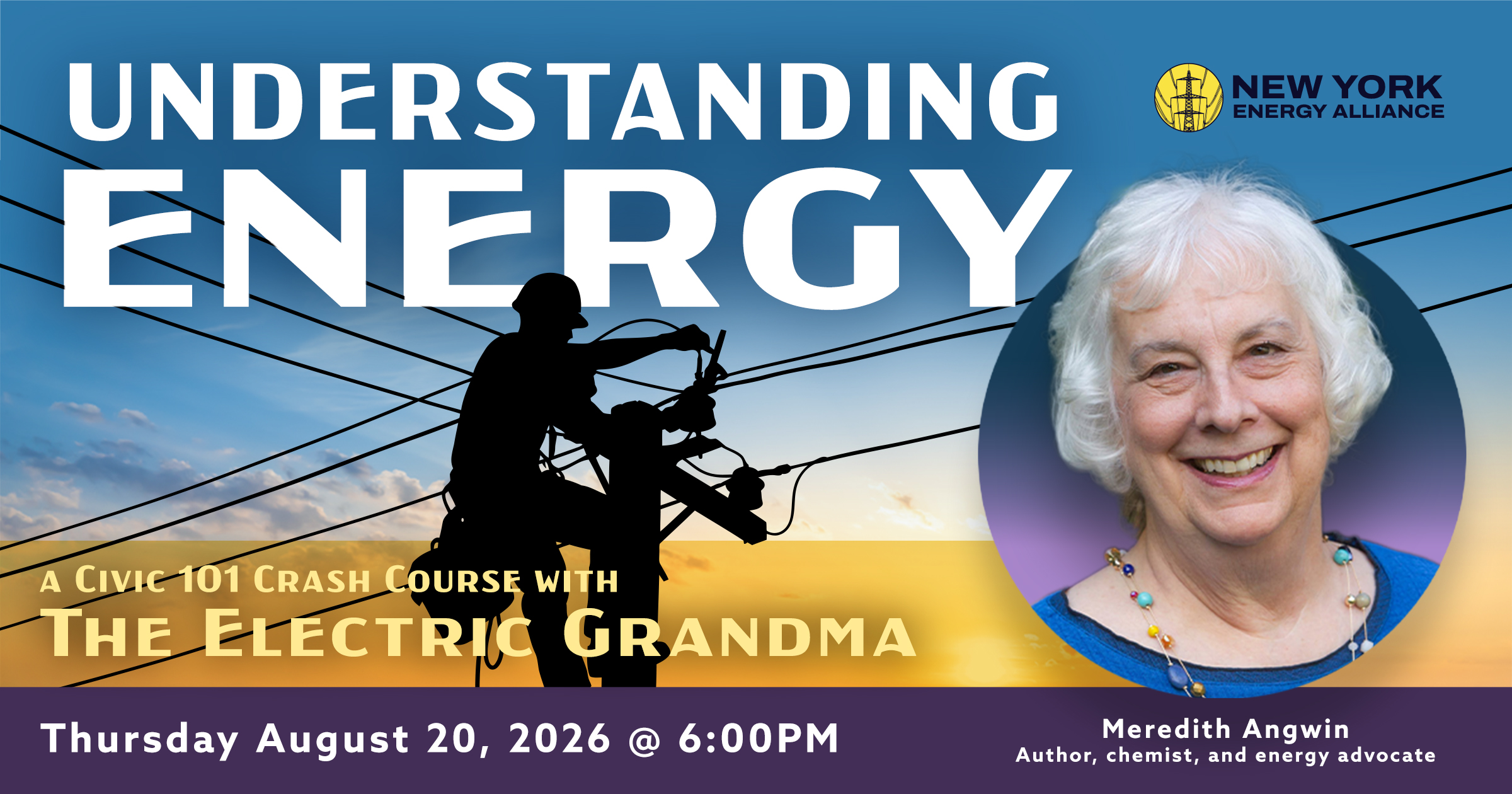
Understanding Energy: A Civic 101 Crash Course with The Electric Grandma
Meredith Angwin, author of Shorting the Grid
Thursday, August 20 · 6:00–8:00 PM
Hurley Reformed Church
Methodology
Rankings: NYEA analysis of EIA-861 (2024 net-metered + distributed PV per residential customer, n=184) and EIA-861M (residential revenue and sales, 2019 vs 2025, n=200), utilities with ≥50,000 residential customers. Heat pumps: NYSERDA Clean Energy Dashboard (Q1 2026) per residential customer, NY utilities. Generation: EPA CAMD