
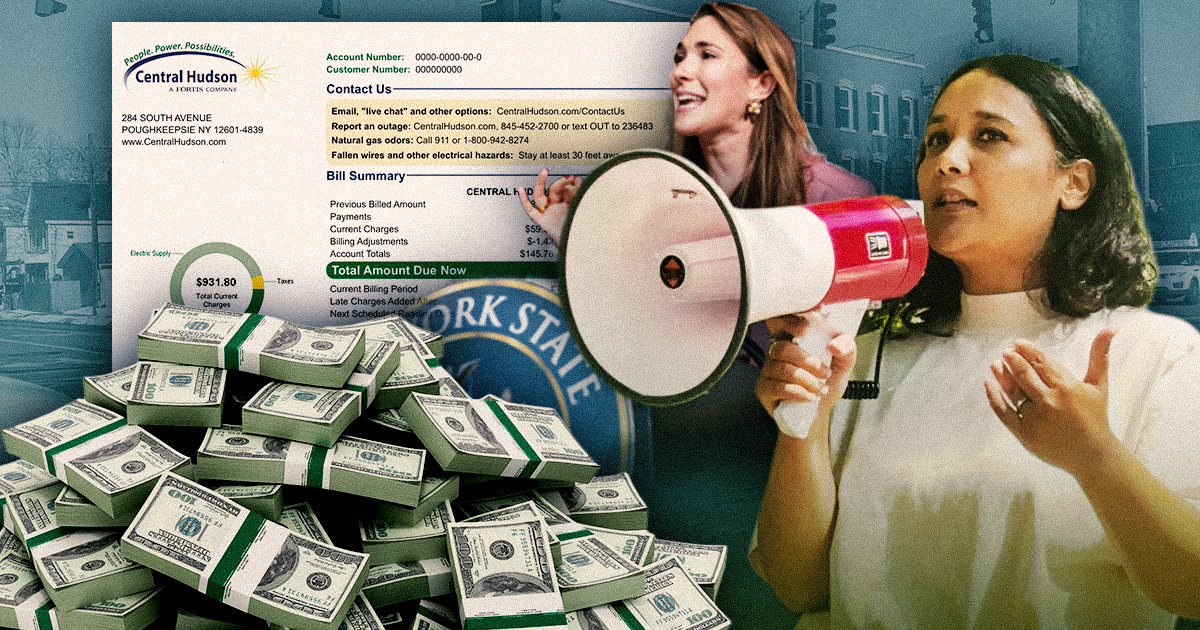
Skyrocketing utility costs have been front and center across the Hudson Valley…
State Senator Michelle Hinchey, January 13, 2026
Families across the Hudson Valley are struggling with rising utility bills…
Assemblymember Sarahana Shrestha, May 28, 2026
On Friday, August 7, forty-eight state legislators wrote to Governor Hochul and the Public Service Commission asking regulators to “require utilities to put electric heating rates in place by the end of 2027,” citing “growing concerns” about “energy affordability” and constituents “facing painful financial pressures.”
Two of them represent the Hudson Valley and heart of Central Hudson’s service territory: Assemblymember Sarahana Shrestha, and Senator Michelle Hinchey.
But what the letter doesn’t say is that for Shrestha and Hinchey’s constituents, six of seven households will have a substantially higher bill if the petition is adopted.
By the petition’s own math, Central Hudson households heating with gas, oil or propane would pay an extra $219 annually, the most in New York, and double the statewide average. That works out to an extra $18.29 a month.
View as table
| Utility | Per year | Per month | Households paying | Share of customers paying |
|---|---|---|---|---|
| Central Hudson | $219 | $18.27 | 232,361 | 85.8% |
| NYSEG | $174 | $14.51 | 689,013 | 87.0% |
| National Grid | $133 | $11.09 | 1,324,257 | 86.4% |
| RG&E | $130 | $10.87 | 299,148 | 85.1% |
| Con Edison | $106 | $8.83 | 2,694,805 | 87.9% |
| O&R | $87 | $7.24 | 191,412 | 90.7% |
| PSEG-LI | $54 | $4.51 | 968,069 | 94.0% |
The money would subsidize the one in seven customers who use electric heating.
“The Grid of the Future”
This all rides on the most important state Public Service Commission proceeding that few ratepayers have ever heard of: Case 24-E-0165, or the “Grid of the Future” docket that opened in April 2024.
The proceeding has become a catch-all for the downstream consequences and details of the state’s 2019 climate law; how to meet new demand from heat pumps and EVs, whose wires get upgraded to carry it, and, in the fine print, who pays for it. It was started in 2024, with the assumption that the climate law would be fully enacted: 70% renewables by 2030, and 100% clean energy by 2040.
Those goals are not going to be met, but the Grid of the Future grinds on in an administrative proceeding. There is no law being debated, no vote, and no budget line; just filings from lawyers.
They want you to pay $18.29 a month, forever. We just want you to pay $15 one time. Join us on August 20 at the Hurley Reformed Church to learn how the grid works from Meredith Angwin, author of Shorting the Grid. Register now.
On May 5, seven organizations: Environmental Defense Fund, Alliance for a Green Economy, Building Decarbonization Coalition, Earthjustice, New Yorkers for Clean Power, Rewiring America and Sierra Club petitioned the Commission to reallocate a total of $740M in delivery costs off of electric heating customers, and onto everyone else.
A month later, seventy-eight organizations filed a letter backing the petition. Most are the statewide climate roster, like the New York League of Conservation Voters, Citizen Action of New York, WE ACT for Environmental Justice, Bill McKibben’s Third Act Upstate and NYC organizations, and 350.org, along with the Public Utility Law Project, the state’s low-income ratepayer advocate. A dozen or so signers sell the product: heat pump installers, a geothermal contractor, and NY-GEO, the geothermal industry’s trade association.
Two Kingston organizations joined their friends at New Yorkers for Clean Power in the letter: Communities for Local Power and Mid-Hudson Energy Transition, both heavily funded by the NoVo Foundation.
That petition is what the letter of August 7 is in support of; though curiously, the letter only cites a $170M figure for heat pump customers, and not petition’s full $740M that includes electric baseboard heat.
On page 45 of the analysis under the petition is the breakdown of costs: $9.64 a month across the state, depending on which utility area the ratepayer is served by.
Central Hudson’s number is the highest in the state for a structural reason: the territory has more electric heating than average, baseboard especially, and far fewer gas customers to spread the recovery across. Only 32 percent of Central Hudson customers heat with natural gas, against 60 percent statewide; half heat with oil or propane, mostly rural homes the gas main never reached.
Who pays, who benefits
In Central Hudson territory, the beneficiaries are the 10,541 households with heat pumps and the 27,957 with electric-resistance heat, or one customer in seven. The other six in seven cover the difference: 87,078 homes heating with gas, and 134,742 with oil or propane.
View as table
| Group | Customers | Share | Effect |
|---|---|---|---|
| Heat pump | 10,541 | 3.9% | pays less |
| Electric resistance | 27,957 | 10.3% | pays less |
| Gas, oil, propane, other | 232,361 | 85.8% | pays more |
At every utility in New York, at least six out of seven households would pay more so that one household could pay less; and on Long Island it’s sixteen out of seventeen.
This is not a clean transfer from the poor to the rich. Census data for the seven core counties shows renters heating with electricity at three times the rate of homeowners. It’s a transfer from one set of mostly modest households with oil-and-propane, to another.
The number behind the number
The supporters’ case is that heat pump customers are already over-collected relative to what it costs to serve them. Their analysis is built on this: between 87 and 98 percent of a delivery bill is “residual,” i.e., sunk costs of the existing grid. The analysis splits that equally across every customer, a choice its authors describe as “a normative decision, not a strictly economic one.”
They acknowledge that other standard allocation methods “would produce different cross-subsidy estimates.” But they published no alternative. The $740M spread across New York ratepayers is downstream of one decision.
The analysis concedes that as heating electrifies, winter-driven costs could arrive “as early as the mid-2030s,” and “the rates we modeled in this report would need to be adjusted upwards to reflect that.” The petition proposes no mechanism for that adjustment; no sunset, no trigger, no scheduled review. The arithmetic that makes this fair depends on a future Commission raising rates on possibly hundreds of thousands of enrolled households, over the objections of every group that just petitioned for the discount. If that adjustment doesn’t come, then the weight on propane, gas and oil customers only grows.
Where this stands
The Grid of the Future plan is due October 30. The petition asks the Commission to direct utilities to implement electric heating rates by December 31, 2027. The letter from the forty-eight legislators asks the Commission to grant it. Central Hudson would not collect more money under this proposal; but costs would be redistributed among ratepayers.
But for politicians who harp on affordability, and taxing the few to serve the many, it sure is strange to see a proposal that will raise costs on the vast majority of people to provide a discount for a few others.
Join Us on August 20 for “Understanding Energy”
She watched New York close Indian Point and called it “a travesty.” She says that New York is relying on a “fatal trifecta” of just-in-time natural gas, renewables, and imports from our neighbors. And on August 20, she’s coming to the Hudson Valley to teach us how the grid actually works, right outside of Kingston.
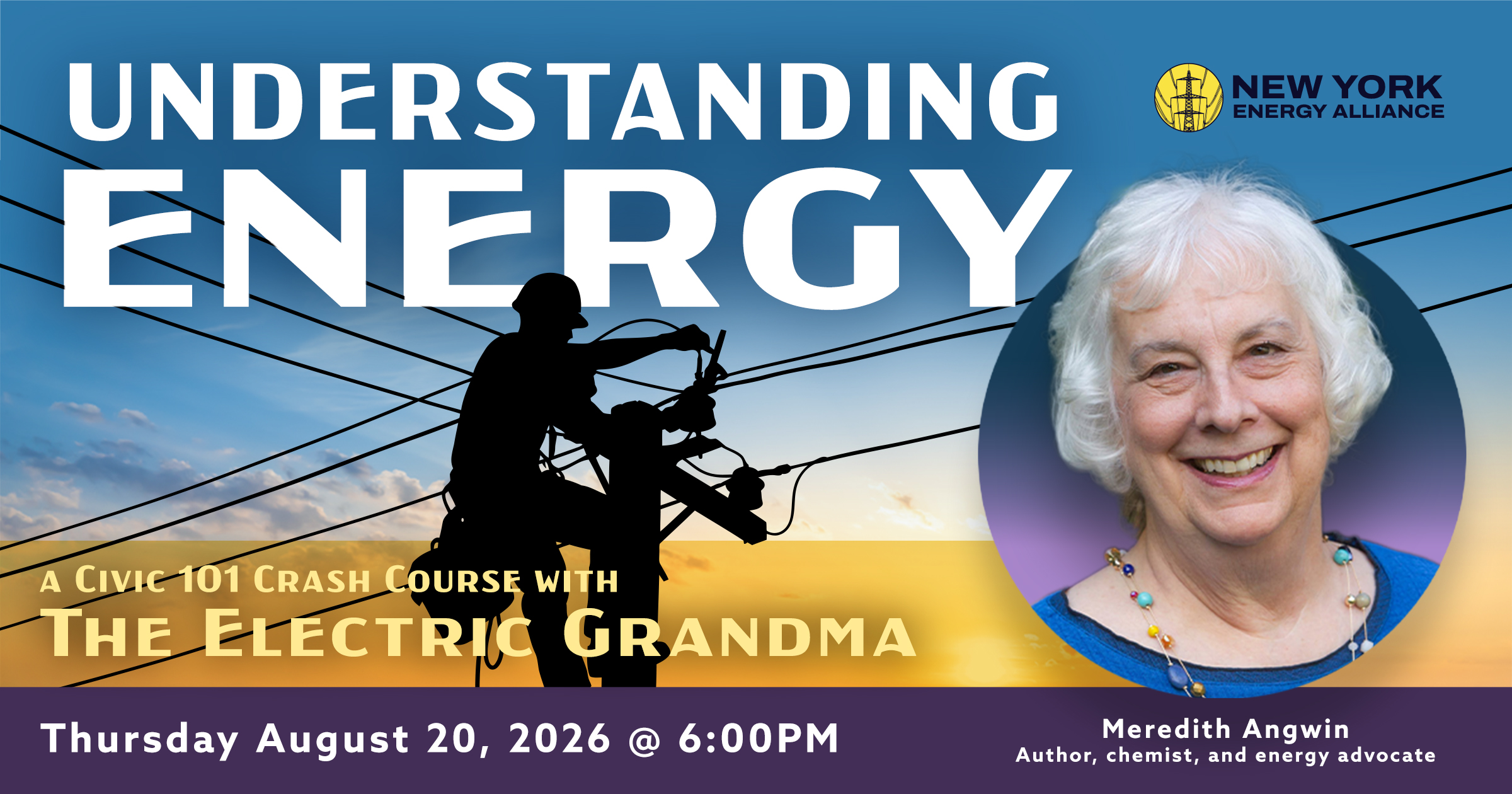
Event Details
Understanding Energy: A Civic 101 Crash Course with The Electric Grandma
Meredith Angwin, author of Shorting the Grid
Thursday, August 20 · 6:00–8:00 PM
Hurley Reformed Church
Methodology: It’s important that anyone can produce these results.
Cost per household: NYEA calculation from the Switchbox analysis filed as Attachment 1 to the May 5, 2026 petition in PSC Case 24-E-0165 (Tables 17–23, pp. 83–86). For each utility, the combined heat pump and electric-resistance cross-subsidy is divided by customers remaining on the default rate (gas, delivered fuels, and other heating). Central Hudson: ($18,264,113 + $32,668,297) ÷ 232,361 households = $219.19/year. The same method applied statewide reproduces the report’s published figures: $170M ÷ 7.1M households ÷ 12 = the $2.00/month it states at p. 39, and our per-utility totals sum to $740.7M against its $741M (p. 45). The full per-utility worksheet is here.
Figures are averages under full enrollment of the modeled rate design, not tariff calculations for any individual household; the Commission could adopt a different design. Statewide totals: petition p. 36; Switchbox p. 45. Winter rate reductions (67–82%): Switchbox Table 4, p. 31. Cost-allocation basis: Switchbox pp. 114–124. Heating shares and customer counts: Switchbox Table 17 (Central Hudson), Table 1 (statewide). Renter/owner electric heating rates: Census ACS 2023 5-year, table B25117, for Columbia, Dutchess, Greene, Orange, Putnam, Sullivan and Ulster counties. Federal credit: IRC §25C, terminated for property placed in service after Dec. 31, 2025 (P.L. 119-21).
Filings cited: legislators’ letter (Aug. 7, 2026), petition and Attachment 1 (May 5, 2026), organizational sign-on letter (June 8, 2026), all in Case 24-E-0165 at documents.dps.ny.gov.