
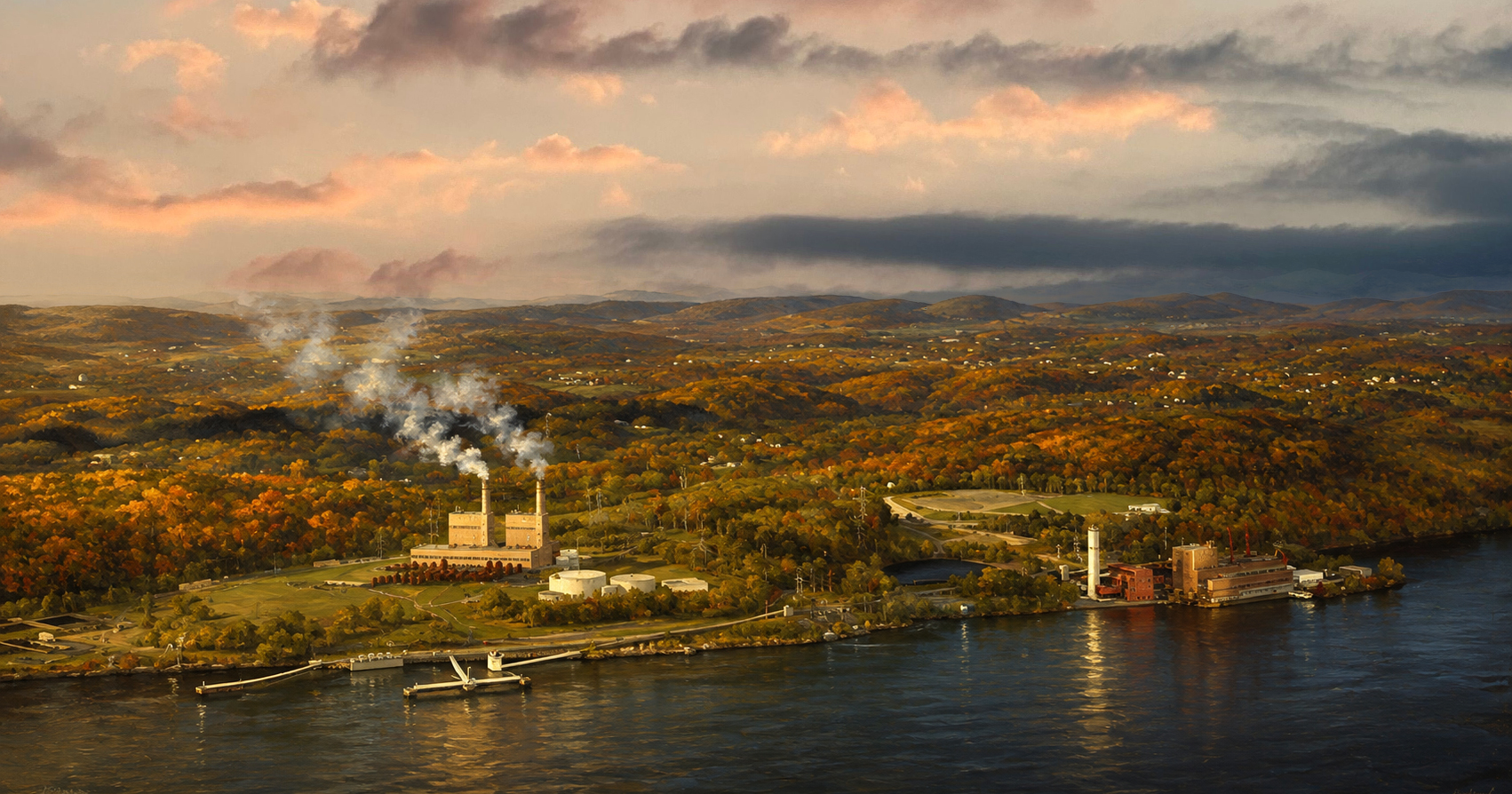
Tomorrow at 10:30 AM, the Public Service Commission is set to approve the sale of Newburgh’s Roseton Generating Station for an undisclosed sum. And the potential future plans for the plant as “powered land” for an “energy campus” with advanced manufacturing or even a data center lie somewhere in between the official filings and press releases.
The plant was built by a group of utilities in 1968 for the modern equivalent of $1.5B, sold off in 2001 after deregulation for $900M, plucked from a bankruptcy auction for $19M in 2013, and now, is being relied upon more than it has in a decade.
The buyer is PT Cloud Power Holdings LLC, a vehicle of PowerTransitions, whose main (10-percent-or-greater) owner is a Swiss company called Partners Group Holding AG. The seller is a subsidiary of Castleton Commodities International, which bought the plant in 2013.
The petition those companies filed with the Commission says, on page 11: “no changes in the day-to-day operations of Roseton Gen will result.”
But the press release the buyer issued says Roseton presents “an exceptional opportunity to develop a multi-use energy campus at scale.” Further in the same release, they say they specialize in “new power generation, energy storage facilities, and powered land for advanced manufacturer and data center campuses.”
The potential range of outcomes is a reflection of the rapidly evolving energy and industry landscape in New York State. Governor Kathy Hochul has been reworking the state’s 2019 climate laws to account for a renewable buildout that has been expensive but has not kept up with our hottest and coldest days, while enacting a one-year data center moratorium to “lead the way in creating the strongest standards in the nation for data center development.”
The Roseton acquisition joins five other acquisitions by PowerTransitions of smaller plants across New York in Hillburn, Shoemaker, Massena, Batavia, and Sterling that total over 1.8GW of “powered land” capacity.
Its redevelopment, if it ever happens, could include some combination of bolted-on battery storage, advanced manufacturing, plant upgrades or data centers. To be clear, no official plans have been published, but that is stated business model of PowerTransitions.
The uncertainty is actually nothing new for Roseton. Its true story all along, has been as a bellweather of the Hudson Valley and New York’s energy grid.
In order for the Hudson Valley to plan for the grid of the future, we need to understand the basics. Join us on August 20 at the M. Clifford Miller Middle School Auditorium to get an Energy 101 education from Meredith Angwin, author of Shorting the Grid. Register now.

The Tivoli nuclear plant that never was
In 1960, when utilities still were responsible for developing power plants, Central Hudson bought roughly a thousand acres at Cruger’s Island and the old Ward Manor estate, between Tivoli and Barrytown, for a new nuclear plant plant.

In 1960, board chairman Ernest R. Acker said the tract could “eventually accommodate up to 2,000,000 kilowatts of installed capacity … almost six times the company’s present total generating capability.”
Two million kilowatts on Tivoli Bays: the scale of both Indian Point reactors combined, sited on 768 acres of marsh, meadow, and a 56-acre island reachable by a spit of land. By the late 1960s the company’s own magazine had narrowed the ambition but not the intent; there was “little question” a plant was coming; the open questions were where on the tract, and whether it would be 500 megawatts or 1,100, the larger figure enough to double the utility’s entire capacity by itself.
A 1,100-megawatt unit meant a steel-lined containment dome on the order of fifteen stories tall, comfortably the tallest structure in northern Dutchess County, a turbine hall the length of a city block beside it, transmission corridors cut back from the river, and once-through cooling from Hudson River water.
New York Energy Alliance
1968 vs 2026: Red Hook Nuclear
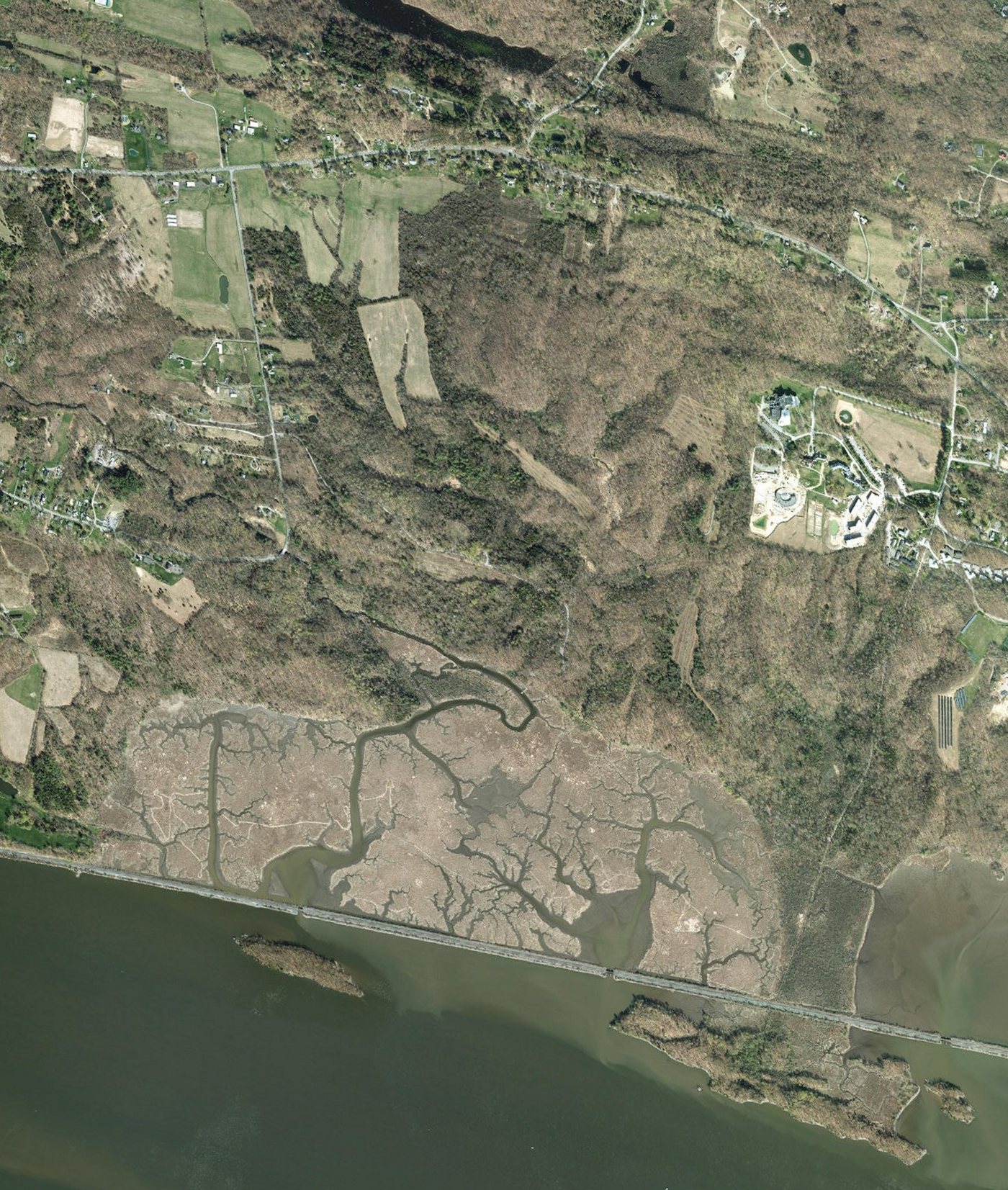
Before a single permit was filed, Central Hudson had quietly assembled the land for a nuclear plant around Tivoli Bays, just north of Bard College — mapped by the Poughkeepsie Journal in January 1968 with the utility’s property outlined in white. Drag the handle to see the same ground today: no reactor was ever built, and the marsh is now the Tivoli Bays Wildlife Management Area. Drag ↔
 1968
2026
1968
2026
1968 aerial: Poughkeepsie Journal, Jan. 7, 1968 (restored scan) · 2026 imagery: Esri World Imagery, rotated and registered to the 1968 camera — north is to the left.
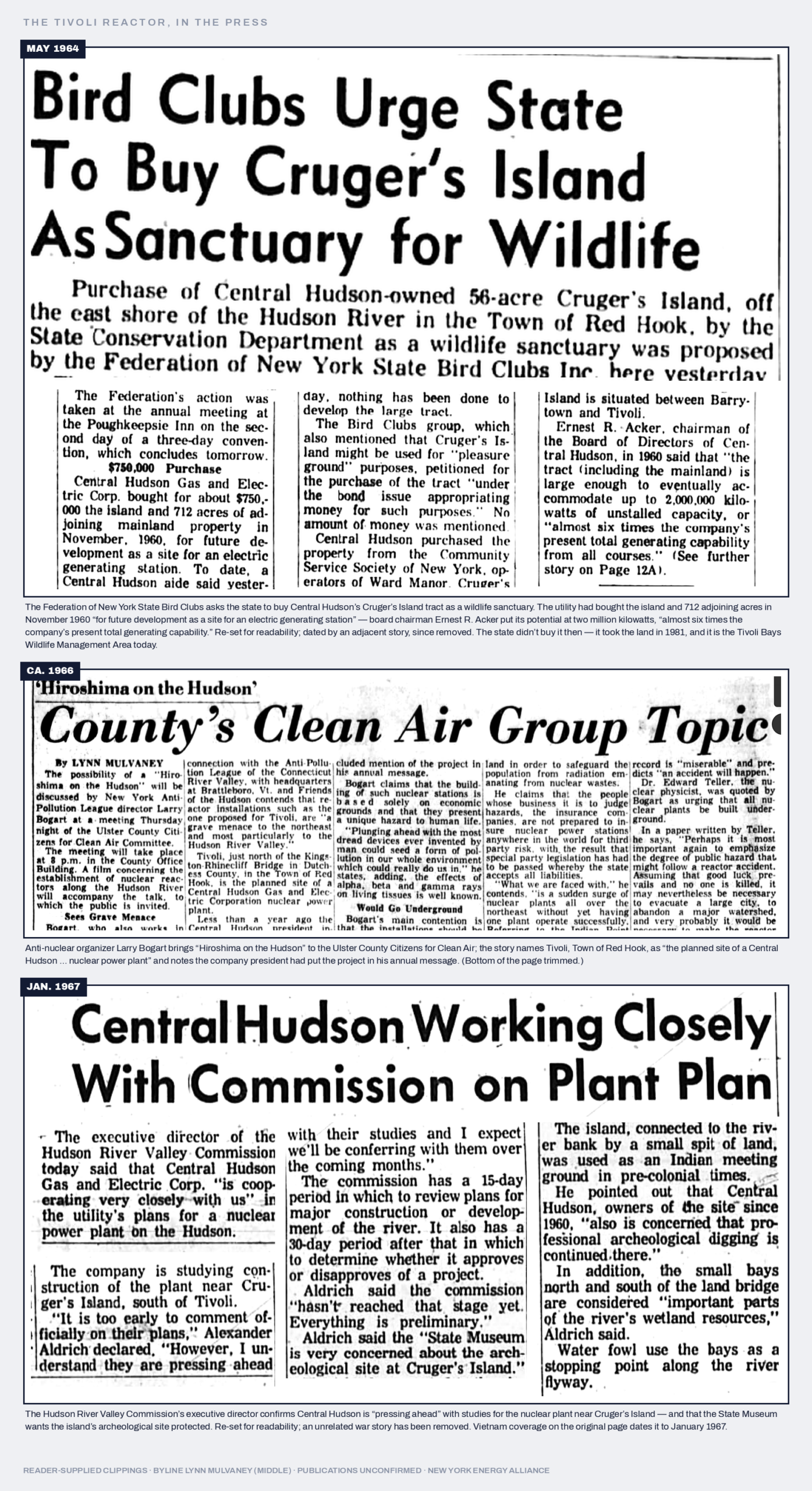
Very quickly, groups like the Hudson River Valley Commission (chaired by Governor Nelson Rockefeller’s cousin, Alexander Aldrich), the New York Anti-Pollution League, The Federation of New York State Bird Clubs, and Friends of the Hudson sprung into action. Their warnings ranged from the site turning into a “Hiroshima on the Hudson,” to Cruger’s Island being a bird sanctuary, and a sacred Native American meeting ground.
Their delay tactics worked. In a pattern all-too-familiar in Hudson Valley history, a clean energy baseload project was blocked or delayed, and a fossil fuel-powered plant was built instead.

On November 7, 1968, Central Hudson, Con Edison and Niagara Mohawk jointly announced Roseton: two 600,000-kilowatt units, oil-fired, $170 million, on the site of an old brickyard where the river channel ran deep enough for tankers. It’s next-door to Danskammer, a 1950s power plant that today is both bankrupt and too critical to allow to shut down.
NEW YORK ENERGY ALLIANCE
1969 vs 2026: Roseton & Danskammer
Before Roseton existed, engineers hand-drew it into the Hudson with a hatched square labeled “Roseton Station,” filed with the Atomic Energy Commission in December 1969. Drag the handle to see the same three miles of river today: Danskammer on the point, Roseton’s tank farm below it. Drag ↔


L: “Effect of Roseton Plant Cooling Water Discharge,” Quirk, Lawler & Matusky Engineers for Central Hudson / Con Edison / Niagara Mohawk, Dec. 1969, Fig. 1 (NRC ADAMS ML100221948) · R: USGS National Map aerial, fetched Aug. 2026, rotated 24° to match the sketch’s frame · Positions approximate — the 1969 figure is a field sketch, not a survey
Roseton’s units entered service in September and December 1974. When a nuclear reactor knocked on Red Hook’s door again in 1976, with Con Edison’s Red Hook–Milan proposal, the town voted it down 1,984 to 88, passed a local law against it that’s still on the books (although they lost at the Court of Appeals).
Central Hudson held the Tivoli land until 1981, when it conveyed to the state for about $710,000. It is now the Tivoli Bays Wildlife Management Area. The oil plant that was built instead is in its 52nd year.
Fifty years of running on a bad bet
Roseton was a rational plant for about twelve months. It was designed around cheap oil. But as it opened, OPEC repriced oil, sending prices up four times what they were just a few years prior.
NEW YORK ENERGY ALLIANCE
Central Hudson Committed to Oil at a 15-Year Price Low
Producer price index for residual fuel oil — No. 5, No. 6 and other heavy fuel oils, the grade Roseton burns. Prices fell every year from 1965 to 1969, the years Central Hudson deferred its Tivoli reactor and announced Roseton. Indexed: 1965 = 100
Data table
| Year | Index (1965=100) | Real, CPI-adjusted |
|---|
SRC: BLS Producer Price Index, residual fuels (WPU0574), via FRED · annual average of monthly values · nominal dollars. CPI-U rose 71% over the decade, so the real increase is 2.7×, not 4.6× · 1969 was the lowest annual average since 1954; series begins 1947
In Roseton’s first summer in service, Central Hudson president H. Clifton Wilson briefed reporters at the company’s Rifton retreat.
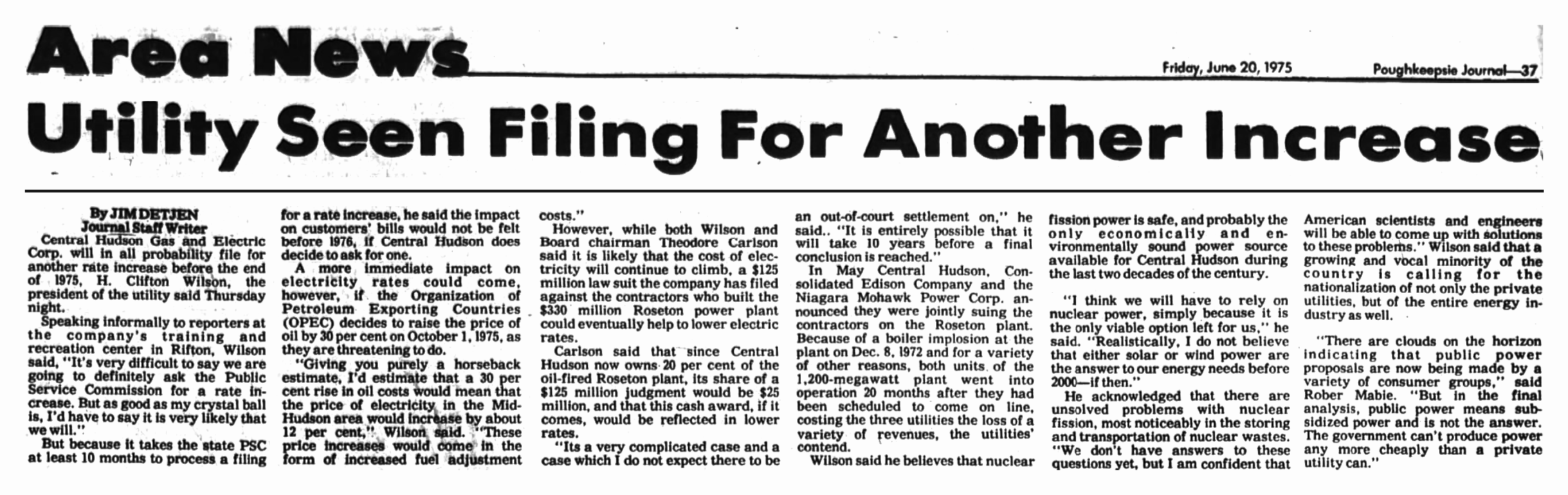
A rate increase was coming: “as good as my crystal ball is, I’d have to say it is very likely that we will.” Wilson calculated that OPEC’s machinations at the other end of the world would raise mid-Hudson electric bills “by about 12 per cent … in the form of increased fuel adjustment costs.”
Nuclear power, Wilson insisted, remained “probably the only economically and environmentally sound power source available for Central Hudson during the last two decades of the century,” and “we will have to rely on nuclear power, simply because it is the only viable option left for us.” Solar and wind were not “the answer to our energy needs before 2000, if then.”
And when the conversation turned to the “growing and vocal minority” calling for public power, the company supplied the rebuttal it would still be using against takeover campaigns a half-century later: “public power means subsidized power and is not the answer. The government can’t produce power any more cheaply than a private utility can.”
Despite the exorbitant cost of oil, there was no choice but to run Roseton to keep the New York grid running 24/7. By 1991, the plant was updated to burn both gas and oil. According to EPA emissions records, during the late 1990s and early 2000s, Roseton ran 300-plus days a year. In 1998 it operated 362 days out of 365 and generated 3.8 million MWh.
NEW YORK ENERGY ALLIANCE
Roseton, 1995–2026: From Workhorse to Standby — and Back
EPA CAMD hourly emissions records, facility 8006 · 2026 through June 30 — before the July and August heat waves · orange = 2019 onward
Days Roseton operated, per year
Annual output, GWh
Data table
| Year | Operating days | Output (GWh) |
|---|
SRC: EPA Clean Air Markets daily apportioned data · gross generation · 2026 partial (Jan–Jun; Q3 loads late September)
By 2005, a new wave of cleaner, more efficient combined-cycle gas turbines came along to make Roseton obsolete. They were Athens Generating (1,222 MW), Albany’s Bethlehem Energy Center (893 MW) and Poletti and Astoria Energy in Queens (1,100 MW).
This caused Roseton’s output to fall by 87 percent in a single year, from 3.7 million MWh to 466,000.
Dynergy, which had bought Roseton and Danskammer from Central Hudson for $903 million in 2001, went bankrupt in 2011, and the auction that followed fetched $23 million for both plants combined.
By 2020, Roseton ran 31 days all year, a 1,242 MW machine operating three days a month, at a 1.1 percent capacity factor.
But then, Indian Point closed, leading directly to Roseton being a lot busier. In 2025 Roseton logged 134 operating days, its most since 2007. Through June 30 of this year it had already logged 50, and the federal data doesn’t yet include July’s heat waves.
NEW YORK ENERGY ALLIANCE
Roseton Is Pacing Its Biggest Year Since 2007
The plant’s first six months of 2026 out-produced five of its last seven full years — before the July heat waves, which federal data hasn’t loaded yet. It is being sold at the peak of its comeback.
Data table
| Year | Output (GWh) |
|---|
SRC: EPA Clean Air Markets, facility 8006, gross generation · solid orange = Jan–Jun 2026 actual · hatch/whisker = full-year pace, 2026 H1 scaled by each 2021–2024 year’s first-half share of output · a second half like 2025’s would imply ~1,400 GWh · Q3 loads late September
The plant’s busiest stretch in nearly two decades is happening right now, in the middle of its sale.
One lost chance to update Roseton
There was only one serious proposal to modernize Roseton.
In 2003, an advocacy study by Pace Law School and Synapse Energy Economics proposing combined-cycle conversion with cooling towers was ignored by Dynergy.
In 2013, as part of the state’s contingency planning for an Indian Point closure, NYPA issued a request for proposals for replacement resources in the lower Hudson Valley. Castleton Commodities closed its $19.5 million purchase of Roseton, and nineteen days later, on May 20, answered NYPA’s RFP with an offer to build 600 megawatts of new, efficient gas generation on the Roseton site itself, in service by early 2018, “potentially replacing one of its two units.”
CCI sold the site’s virtues in similar exact terms PowerTransitions uses today: an active generation site with existing transmission interconnection into Zone G, existing water access and treatment, “substantial open acreage for expansion,” development “with minimal disruption to the environment or local community,” construction jobs and permanent skilled jobs.

But the Public Service Commission chose transmission upgrades and efficiency over any new generation, and the proposal died without ever becoming a filing. When Indian Point finally did close, the new combined-cycle capacity that helped fill the gap was built elsewhere, at CPV Valley and Cricket Valley, with plants of exactly the vintage CCI had proposed for Roseton.
In 2018 Danskammer, Roseton’s elderly neighbor, filed to replace its 1950s steam units with a new 536 MW combined-cycle plant.
In October 2021, DEC denied its air permit under Section 7(2) of the climate law: the new plant would be inconsistent with statewide emissions limits. Today, Danskammer is bankrupt, but kept open because even though the 12th-most rooftop and community solar per capita was added in the Central Hudson territory since 2019, there’s nothing else that can cover the peak on the hottest and coldest days of the year.
Roseton’s own air permit expired on December 4, 2021, five weeks after the Danskammer denial. The plant has run for nearly five years since on an administrative extension. When DEC finally published the draft renewal this April, the Permit Review Report disposed of the climate question in two sentences: “There have been no changes to the existing power plant. A Climate Leadership and Community Protection Act (CLCPA) assessment is not required since this permit is for a straight renewal and no modifications are being proposed.”
Any changes to the plant will trigger a review. As the Hudson Valley famously is the nucleus of non-profit American environmentalism, Roseton’s eventual plans may become a flashpoint for the future of the state’s grid.
A quiet sale
The sale petition was filed with the PSC on May 7, eight weeks before the public announcement on July 1.
Commission precedent supports application of the Wallkill Presumption to the Proposed Transaction. Here, the Proposed Transaction involve only ownership interests in an upstream holding company, Roseton Holding, the indirect owner of Roseton Gen and the Facility. All transfers will occur upstream of Roseton Gen, the direct owner of the Facility, and no changes in the day-to-day operations of Roseton Gen will result. Because Roseton Gen serves no captive ratepayers, none can be harmed by the Proposed Transaction. Private owners will continue to bear all financial risks associated with the operation of Roseton Gen and the Facility. The Proposed Transaction will create no competitive concerns sufficient to override the Wallkill Presumption.
VERIFIED JOINT PETITION FOR DECLARATORY RULING REGARDING A PROPOSED TRANSACTION OR IN THE ALTERNATIVE, FOR APPROVAL PURSUANT TO SECTION 70 OF THE PUBLIC SERVICE LAW, filed by Roseton Holdings LLC, Riverview Power Holdings LLC, and PT Cloud Power Holdings LLC on May 6, 2026.
Because only holding-company interests change hands and no captive ratepayers are being affected, no further review is needed. That is exactly what the PSC’s consent agenda is set for, and even the promise of grid-scale batteries will not nearly match what Roseton can do.
New York Energy Alliance
Setting Expectations for Batteries
A common assumption in the Hudson Valley is that a wave of battery projects will replace fifty-year-old plants like Roseton. One is already in the interconnection queue at Roseton’s own substation: RWE’s Farmhouse BESS — 150 MW for four hours, targeting 2029. Below, what Roseton actually delivers in a day, measured in full Farmhouse charges.
Each cell = one full Farmhouse charge (600 MWh)
Farmhouse BESS — one full charge 600 MWh
1×
Roseton — average operating day, 2025 5,401 MWh
9×
Roseton — hardest day, 2025 15,412 MWh · Dec. 15
26×
Roseton — hardest day, 2022 28,814 MWh · Dec. 25, Winter Storm Elliott
48×
The entire proposed Hudson Valley battery fleet — 18 projects, some 2,800 MW across every project on the map — holds roughly two average Roseton days’ worth of energy, and less than one hard one. It would then need to recharge from a Zone G grid where gas sets the price in 80% to 94% of charging-window hours.
Roseton daily output: EPA CAMD daily apportioned gross load, units 1–2; average is per operating day (134 days in 2025). Farmhouse BESS: NYISO interconnection queue C24-098 — RWE, 150 MW / 600 MWh at the Roseton 345 kV substation, proposed COD June 2029. Charging mix: 12 months of NYISO real-time data, Hudson Valley charging-window hours.
As Roseton Goes, So Does New York
Today, Roseton stands at a crossroads on the waterfront. For the Hudson Valley and state policymakers to make the right decisions about it, they need to understand how we got here, because we’ve been here before.
Nobody ever decided what Roseton should be. In 1960, Central Hudson bought a thousand acres at Tivoli for a nuclear plant. There were lots of loud warnings about the dangers, and the alternative, then as now, was to burn oil and gas at plants like Roseton.
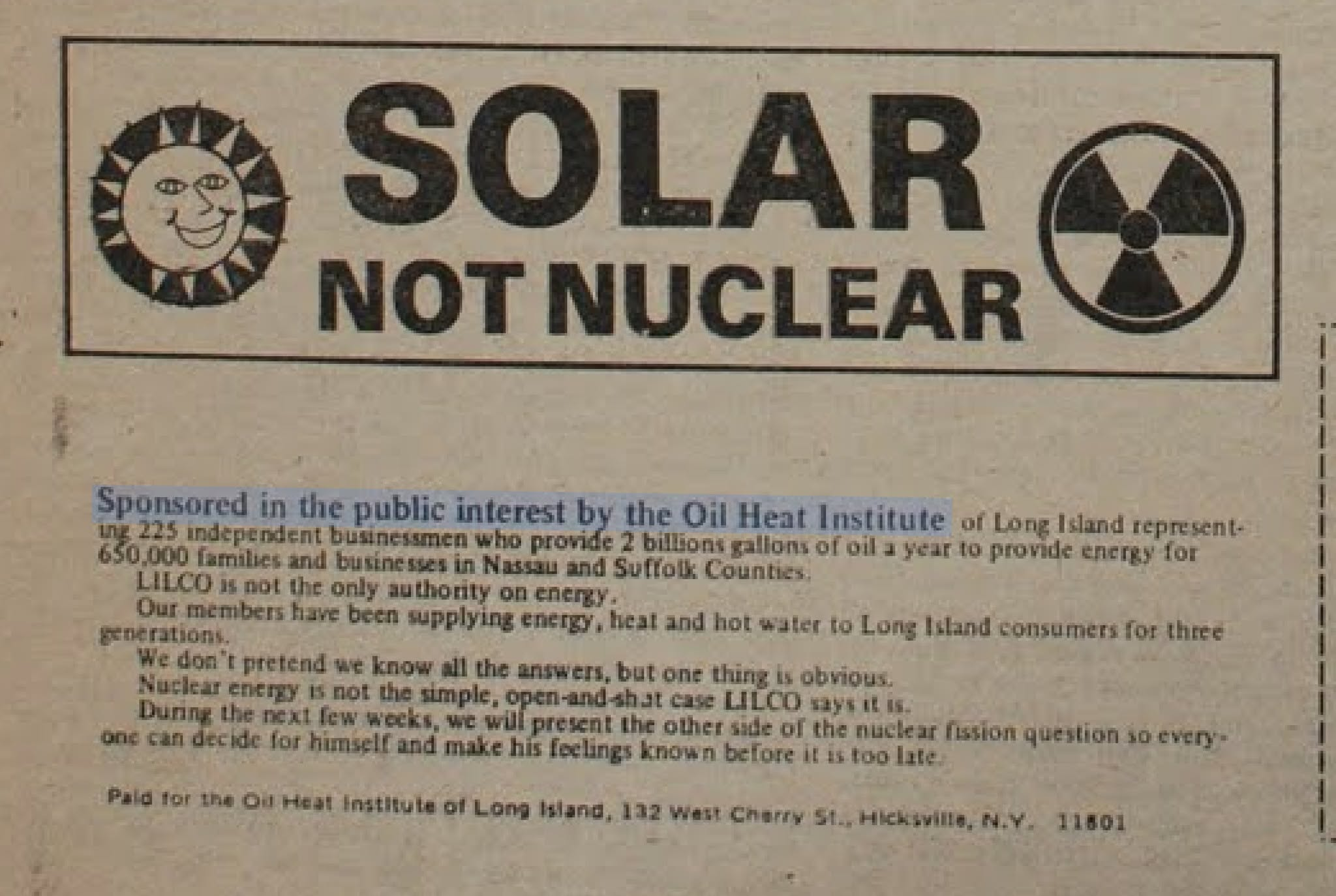
As Roseton’s put out its first watt, OPEC ended cheap oil forever. The nuclear plants that were supposed to replace it, at Indian Point, Red Hook, Cementon, and more, died one by one from referendums, lawsuits, Volcker-era interest rates, and a fear campaign that has outlived every assertion it was built on.
Roseton burned oil and gas for the valley for decades, was sold off in the deregulation wave, got lapped by modern combined-cycle plants, and spent the 2010s running on fumes. Indian Point closing breathed new life into Roseton, which has always been the placeholder. Today, it’s one of the few plants left standing, older than almost everyone who will vote on its sale.
On Thursday, its future changes hands. What is it to become, and who will decide?
Join Us on August 20 for “Understanding Energy”
She watched New York close Indian Point and called it “a travesty.” She says that New York is relying on a “fatal trifecta” of just-in-time natural gas, renewables, and imports from our neighbors. And on August 20, she’s coming to the Hudson Valley to teach us how the grid actually works, right outside of Kingston.

Event Details
Understanding Energy: A Civic 101 Crash Course with The Electric Grandma
Meredith Angwin, author of Shorting the Grid
Thursday, August 20 · 6:00–8:00 PM
M. Clifford Miller Middle School, 65 Fording Place Rd, Lake Katrine · $15