
Per megawatt-hour, by NYPA’s own estimate in its 2025 renewables plan.
You pay in more than can ever come back
Per megawatt-hour, using NYPA’s own cost and market estimates from its 2025 renewables plan.
New York’s Public Solar Will Not Lower Your Bill
New York’s public power law was sold on a promise: state-owned solar would make money, and that money would cut electric bills. Here is what the state is actually buying.
On Monday, the New York Power Authority announced it will take a 51 percent stake in Rich Road Solar, a 240-megawatt project in St. Lawrence County. EDF, the developer that initiated the project, keeps the other 49 percent. NYPA President Justin Driscoll called it “the first NYPA project to leverage a public-private partnership model,” a structure that lets NYPA secure expiring federal tax credits.
It joins Somers Solar, a 20-megawatt array in Fort Edward that NYPA calls its first renewables project to advance to construction.
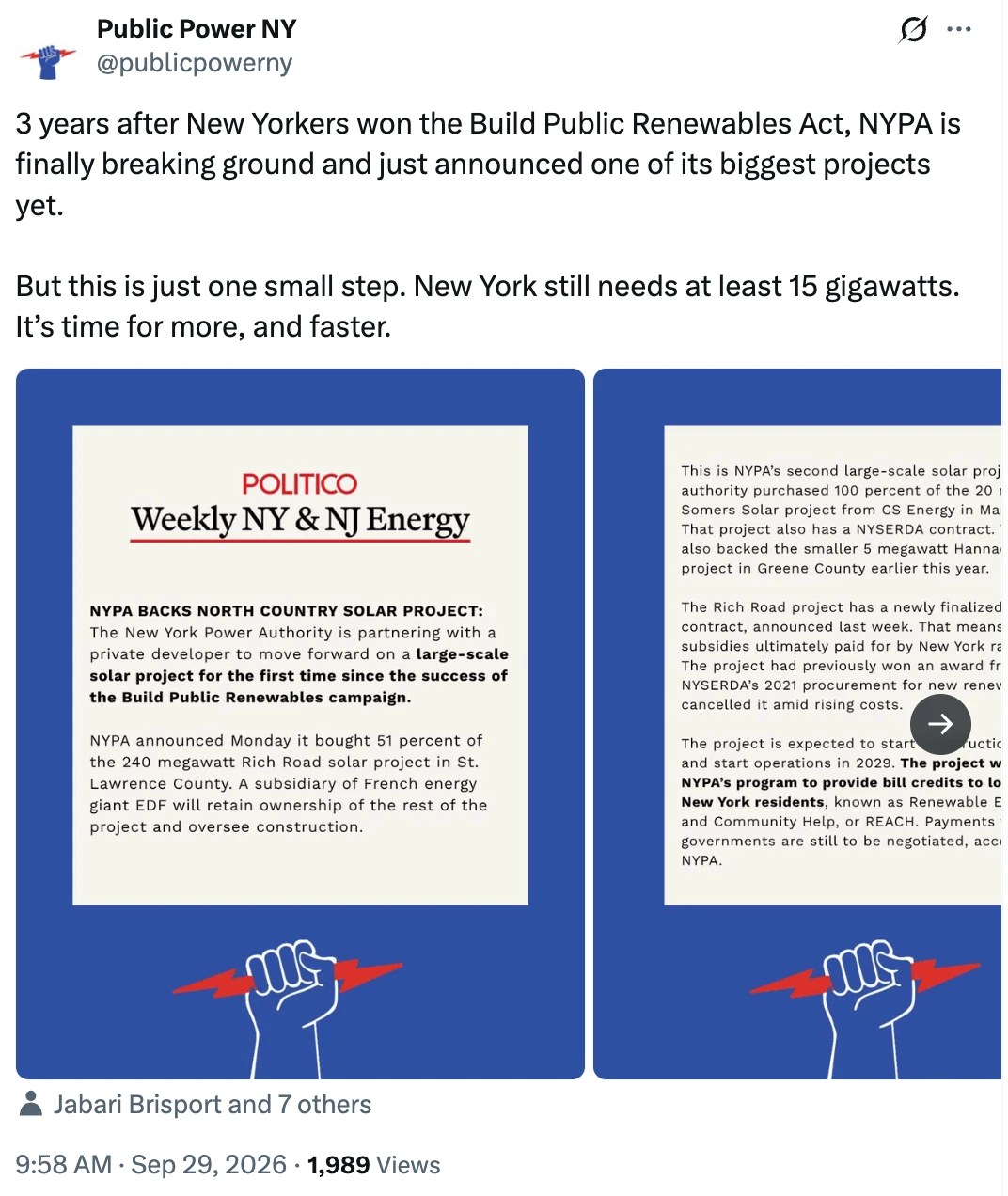
Public Power NY, the coalition that campaigned for the Build Public Renewables Act, celebrated. “3 years after New Yorkers won the Build Public Renewables Act, NYPA is finally breaking ground and just announced one of its biggest projects yet,” it posted. “But this is just one small step. New York still needs at least 15 gigawatts. It’s time for more, and faster.”
Politico’s reporting says that Rich Road had won a NYSERDA award in 2021 but “cancelled it amid rising costs,” and that its new state contract means “it will get subsidies ultimately paid for by New York ratepayers.”
Public Power NY and its allies have claimed these projects will provide bill credits to low-income New Yorkers without adding to ratepayers’ costs. “For the first time ever at this scale this relief will not be paid for by ratepayers,” Assemblymember Sarahana Shrestha said when the law passed.
But the devil is in the details. There are no profits to redistribute. NYPA’s own strategic plan says new renewable projects “cannot cover their costs just selling their outputs into the NYISO market alone.”
In effect, the projects collect ratepayer subsidies on every megawatt-hour they produce, and the bill-credit program, REACH, hands back whatever share NYPA’s trustees decide. The Public Service Commission set no minimum.
Whatever comes back is a slice of money ratepayers paid in first.
Rich Road is a canary in the coal mine. Twenty of the 29 private partnerships in NYPA’s renewables plan are projects whose earlier state deals had already failed.
Nine of them already hold permits from the Office of Renewable Energy Siting (ORES), the state office created in 2020 to speed large renewable projects, with the power to waive local laws it finds “unreasonably burdensome.”
What they lacked was a buyer, and ratepayers are still that buyer.
Instead of lowering New Yorkers’ bills, the projects will add to them.
A promise of cheap energy
"NYPA can use profits from renewable energy to lower bills for New Yorkers currently struggling to pay them."
State Sen. Julia Salazar and Assemblymember Sarahana Shrestha wrote that in City & State in July 2024. Because NYPA "can finance its own projects and secure even more funding through the federal Inflation Reduction Act," they wrote, "we can have all of these benefits without raising utility rates or taxes by a cent."
The line has been repeated before, during and after the passage of the Build Public Renewables Act:
When NYPA put its updated renewables plan out for public comment in the summer of 2025, 4,451 of the roughly 6,150 comments it received were one identical letter. It told the Authority that building 15 gigawatts would "lower electricity bills" and "make energy more affordable." The letter also called for "expanded bond financing," meaning more public borrowing, to build "regardless of federal tax credits."
This promise of cheap energy for low-income New Yorkers, along with meeting New York's 2019 climate goals, is the claimed justification for everything that follows.
What the law says
The Build Public Renewables Act passed as part of the 2023 state budget. It lets NYPA build solar and wind "either alone, or jointly with other entities," meaning with private companies, as long as NYPA owns the majority. It requires NYPA to write a plan and hold public hearings on it, and it created the REACH bill-credit program.
It does not set a target. NYPA's own plan says the law "does not direct the Power Authority to build a specific amount." The 15 gigawatts comes from the campaign, not the law.
What NYPA is actually doing
NYPA's plan doesn't name its projects. Each one gets a code like "Project B1." That means a neighbor reading the plan can't tell whether the field next door is on the list. But each entry lists the town, the size and the private partner. That's enough to figure out which project it is.
We matched every project in NYPA's plan against the state's public records. Here's what we found:
| NYPA’s renewables plan (Dec. 2025) | Projects | Megawatts | Share |
|---|---|---|---|
| Partnerships with private developers | 29 | 4,035 | 100% |
| Earlier state deal had fallen through | 20 | 2,829 | 70% |
| No failed deal found in state records | 9 | 1,206 | 30% |
| NYPA building on its own (for comparison) | 13 | 226 | — |
Source: NYEA analysis matching each project in NYPA’s Dec. 9, 2025 Renewables Strategic Plan (by town, size and partner) to NYSERDA’s contract database and state siting records. “Fell through” means a signed NYSERDA contract was cancelled or a 2021 award was never signed.
New York Energy Alliance
NYPA’s Renewables Plan
11 projects hold ORES permits
Projects in NYPA’s December 2025 renewables plan, by how they were sited. Most cleared state siting; what failed for them was the NYSERDA power contract.
Tap or hover a dot for details. Dot area proportional to megawatts. Locations from NYSERDA’s project database (some ZIP-level) or town centroids. Projects matched by partner, town and size in NYPA’s plan to NYSERDA and ORES records; unidentified entries omitted. Sources: NYPA Updated Renewables Strategic Plan (Dec. 9, 2025); ORES/DPS dockets; NYSERDA data.ny.gov dprp-55ye (retrieved Sept. 29, 2026); PSC Case 17-F-0598. Map: New York Energy Alliance.
Some of these projects cancelled so they could re-bid at a higher price later. But every one of them reached a point where the deal the state had offered no longer worked for the company.
NYPA isn't hiding this. Its first plan has a section titled "Investigating 'At-Risk' Projects." It says NYPA has been talking with private developers whose projects "are uncertain or unlikely to move forward," to see whether NYPA's help "could bring an 'at-risk' project to completion."
NYPA is also racing a deadline. Federal tax credits for solar and wind are expiring. In July, NYPA told its board it had spent six months trying to lock in credits for "as many projects as possible."
At Tuesday's board meeting, NYPA president Justin Driscoll said NYPA had completed initial due diligence on 'approximately 6.4 gigawatts of opportunities' from 18 pre-qualified developers.
There is no profit to redistribute
If these projects truly created valuable energy, then they would both pay for themselves and generate some excess revenue to be redistributed.
But according to NYPA's own numbers, a new solar farm costs "at least $100" to produce a unit of power (a megawatt-hour). Selling that power on the open market brings in "less than $50." Something has to cover the gap.
That something is a contract with NYSERDA, the state energy agency. The state promises the project a set price. When the market pays less than that, the difference comes out of electric bills. NYPA's projects get these contracts the same way private ones do. Somers won one in 2024 with "NYPA" listed as the developer. So one state agency owns the project, and another state agency pays it with money collected from your bill.
Five ways in, one way out
Who pays for the solar projects in NYPA’s renewables plan, and what comes back.
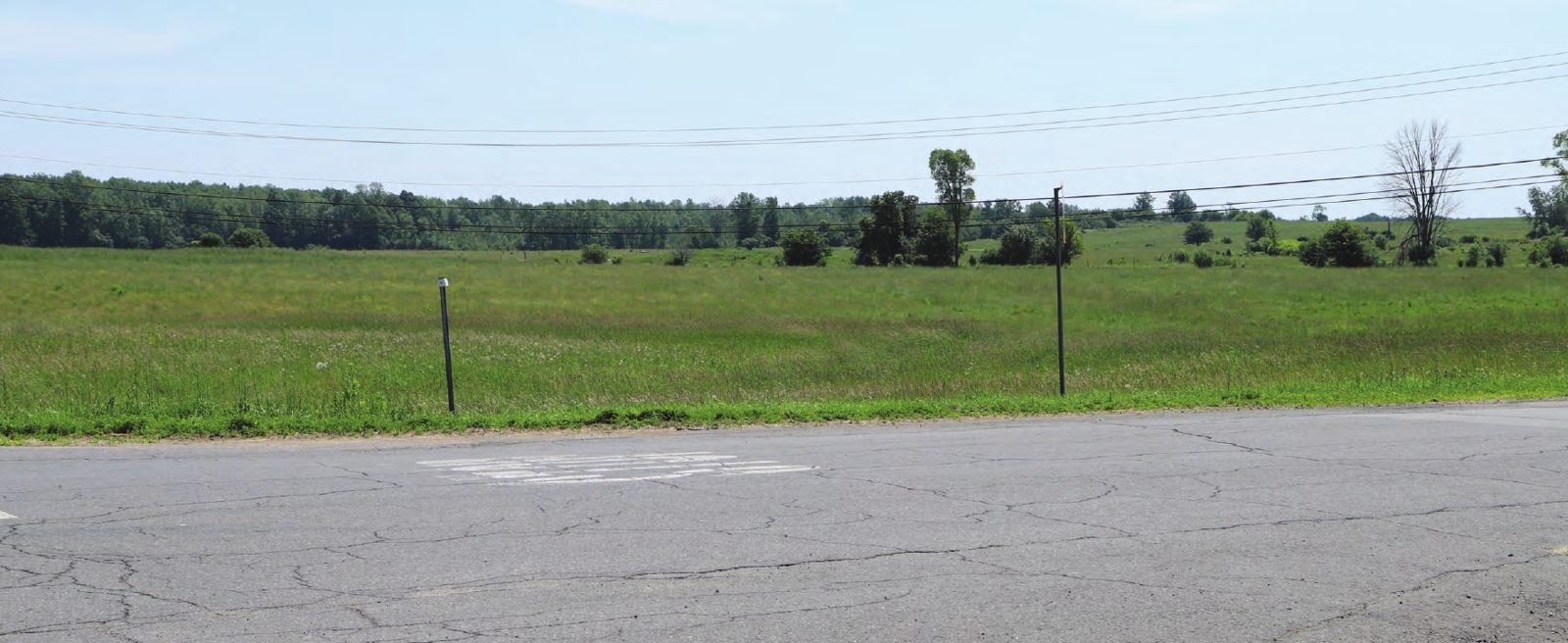
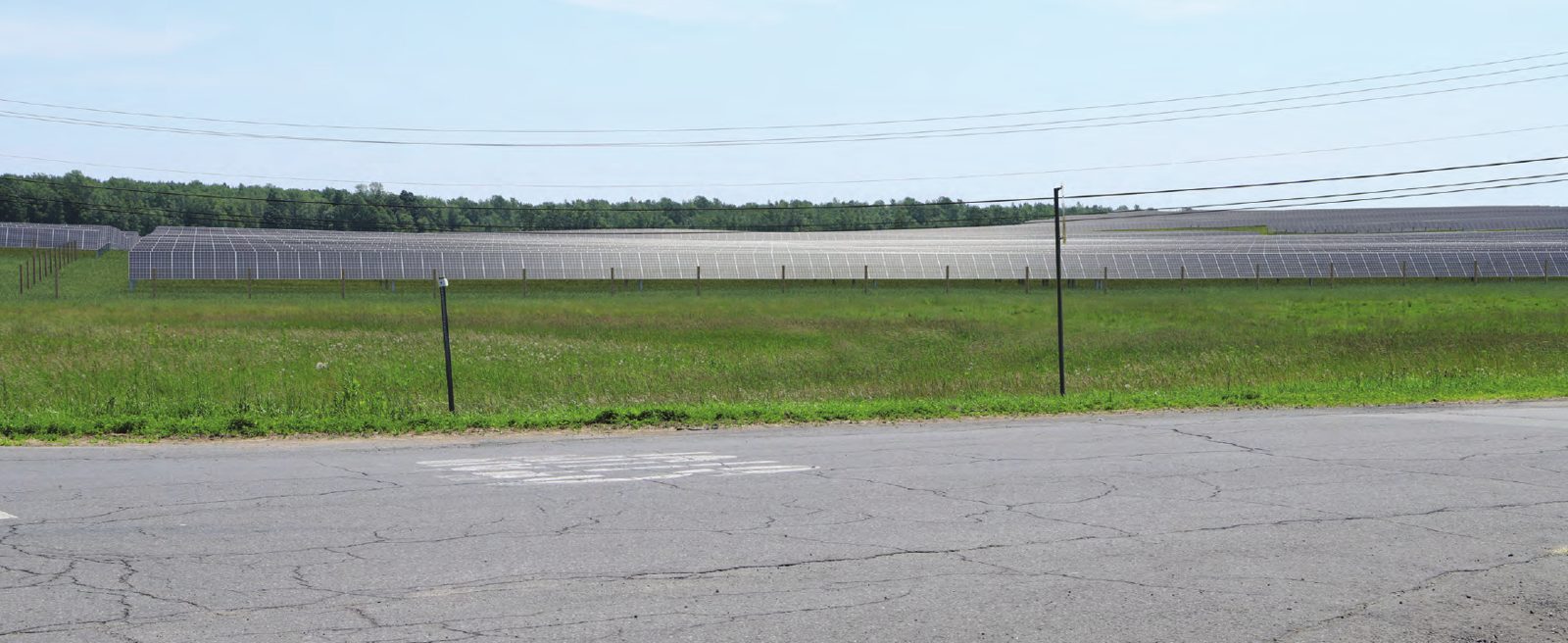
Rich Road Solar, Canton: developer’s photo simulation, ORES application Exh. 8.
Sources: NYPA Renewables Strategic Plans (Jan. and Dec. 2025); NYPA board minutes, July 28, 2026; NYPA 2026 budget and financial plan; PSC order in Case 24-E-0084 (REACH, Oct. 16, 2024); NYPA bond disclosures on Smart Path Connect cost recovery; NYSERDA award records. The $920 million is an upper bound for NYPA’s share of the line, which serves more than these projects.
The rescued projects are also coming back more expensive:
- The 2021 contracts that Rich Road and several others won (and never signed) averaged $63 per megawatt-hour.
- The state's 2023 round averaged $95, about 50 percent more.
- Two projects in NYPA's plan show the jump directly. Garnet went from $69 to $105. Trelina went from $68 to $105. That increase is paid through electric bills: up to roughly $20 million a year between those two projects, for 20 years.
NYPA's pitch for public ownership is that it can borrow more cheaply than private companies. But its own plan admits that owning these projects also causes complications. Public owners miss out on some tax breaks private companies get, worth "10% to 15% of the value of a project." Using cheap public bonds can cut the federal tax credits "up to 15%." And if a project misses federal buy-American rules, a public owner can lose the whole credit, "up to 40% of the project cost," while a private owner would lose only a small bonus.
NYPA says owning projects will let it offer "lower bids," meaning cheaper contracts. There's no way to check that, because the prices are secret until the plants are built.
NYPA says REACH credits could "begin as early as January 2027." But the money for them is supposed to come partly from "the sale of its Renewable Energy Certificates," and yet again, the state pays for those certificates through ratepayers' electric bills. Whatever eventually and hypothetically reaches a low-income household is a slice of what every ratepayer paid in first.
The ORES Connection
The law allows NYPA to partner with, and effectively de-risk private developers as long as NYPA owns a majority. The partners are the same developers the public power campaign said the state should stop relying on: NextEra, AES, Boralex, Repsol, EDF, Invenergy, Avangrid and more.
NYPA hasn't said what it's paying for its shares.
Several of these projects are ones local towns and community groups fought, and lost, at the state siting office. Without NYPA sweetening the deal, the projects could still be in limbo:
- Mill Point Solar, Town of Glen: the town, a local farmland group and Montgomery County all objected. The state approved it in January 2026.
- Horseshoe Solar, Caledonia and Rush: both towns appealed. The state approved it in 2022.
- Fort Edward Solar: Alexandra Fasulo's American Rescue Fund appealed. The state approved it in May 2026.
- Shepherd's Run, Copake: rejected once, resubmitted smaller, and still waiting on a decision after a hearing in Copake on September 14.
The bottom line
Public power advocates are celebrating a project that failed once as a private deal and came back with a public co-signer.
A private developer keeps 49 percent of it. Its power still can't pay for itself on the open market, so electric customers will cover the gap for 20 years, at a price the state won't disclose until the plant is running.
Taxpayers are adding $300 million from the state budget, federal tax credits paid out as cash, and a power line billed to every person in New York.
And the bill credits that were supposed to make it all worth it can only hand back part of what ratepayers put in first, in whatever amount NYPA's board decides. In order to hit their stated goal of 15 GW, New York only has to repeat what it did at Rich Road 61 more times.