New York’s electric grid is nearing the end of its runway. NYISO, the independent operator responsible for keeping the lights on, is issuing its most urgent reliability warnings in decades. Meanwhile, the incoming mayor of New York City, Zohran Mamdani, is elevating advisors whose policy positions directly increase the risk of blackouts and higher energy costs.

Mamdani announcing his transition team on November 24, 2025.

The great irony of the recent New York City mayoral election is that while Mamdani thrashed his opponent Andrew Cuomo, he is going to do everything in his power to continue implementing the former governor’s signature 2019 climate law. Mamdani’s transition team is dominated by the same groups that closed Indian Point, oppose all gas infrastructure, and want to retire every NYC peaker plant by 2030 even though no replacement exists.

The stakes could not be higher: if this coalition gets its way, New York will continue down a path NYISO says leads to rolling blackouts as early as 2026.

New York’s Energy Landscape

The 2019 passage of the Climate Leadership and Community Protection Act got headlines for being “nation-leading” and ambitious, but it delivered a raw deal to New Yorkers: we have to pay to build out a renewable energy grid that is both less reliable and more expensive and creates land use, public safety and home rule conflicts up the ying-yang.

Former Governor Cuomo signing the CLCPA in 2019.

It mandated a massive expansion of heat electrification, while also mandating the shutdown of natural gas plants that can create electricity on cold nights. It mandates that new housing has to shoulder the costs of all-electric heat instead of tapping into existing natural gas infrastructure. It also mandated a solar energy buildout across a state that has famously cold and dark winters.

In addition to consumer bills skyrocketing, multiple grave warnings have been issued that the state will not be able to continue on the path that it’s on. Governor Kathy Hochul faces a court-ordered February deadline to either replace the CLCPA with a new energy policy, or implement upcoming mandates that will be harsher and more draconian measures than anything to this point. She must act carefully, as the New York Independent System Operator (NYISO) has warned of “reliability violations” in New York City beginning as soon as next year.

NYISO Comprehensive Reliability Plan, 2025

More than half of all fossil fuel peaker plants in NYC are now scheduled for retirement before a viable alternative is built.

Hochul Slowly Shifting to Reality

After delaying the inevitable until last year, Hochul pivoted to a healthier “all of the above” energy mix that includes a new 1 GW nuclear reactor and the desperately needed Northeast Supply Enhancement gas pipeline into New York City. She has weathered challenges from environmentalists who fought against the CHPE hydopower pipeline into New York City, and she helped make the Build Public Renewables Act more tolerable by slowing down its rush to close clean peaker plants in New York City.

Hochul announcing her order to NYPA to build 1 GW of new nuclear energy.

The 2026 primary between Governor Kathy Hochul and her former Lieutenant Governor Antonio Delgado is a tightrope walk, as she must lower costs and create stable energy to drive economic development. Delgado, for his part, is campaigning on doubling down on Cuomo’s CLCPA plan and has promised the world to Bill McKibben, the most extreme climate groups, and most importantly, to mayor-elect Zohran Mamdani.

Although he kept quiet about climate on the campaign trail, Mamdani’s political career was built on pursuing extreme climate goals, above and beyond even the CLCPA. He is part of a network of environmental NGOs that simultaneously have closed Indian Point nuclear plant, ignored the rise in emissions and reliability costs, want to use state capacity to take over upstate land for solar mega-farms, and also believe that all fossil fuel infrastructure is a “stranded asset” even though more people are relying on them than ever.

Mamdani has described the CLCPA as mandating 100% renewable energy, when in reality it only mandates emissionless energy.

With New York City accounting for the largest share of demand, emissions, and political pressure in the state, the energy agenda set by mayor-elect Mamdani will play a major role in New York’s direction.

The Choice Between Affordability or Climate Change

While Mamdani said that “we should consider” nuclear energy upstate to help meet New York’s energy needs, he has been clear about the Northeast Supply Enhancement pipeline: he doesn’t believe in investing in any fossil fuel infrastructure.

This is a clear diversion from Governor Hochul, who has greenlit the plan to relieve a crippling and expensive energy bottleneck into New York. It would pay for itself in two years and would reduce the use of dirty “dual fuel” generators by relieving transmission constraints.

Mamdani’s latest shot against Hochul’s all-of-the-above approach came in his picks for a Transportation, Climate, & Infrastructure transition team. Despite Mamdani’s noted campaign emphasis on affordability over doomsday climate prognostications, his choices signal otherwise.

This team has little representation from utility labor or grid management experience.

Of 33 team members, 20 have some kind of track record with energy issues, almost exclusively as non-profit activists. Of those 20, 16 are drawn from the same coalition that, in loose terms, has closed Indian Point, ignored the resulting increase in fossil fuel use, opposed every major gas project since, wants to carpet upstate farmland with solar, while retiring every peaker plant in the five boroughs by 2030.

Upstate, dozens of towns have blocked battery storage and solar megafarms, setting up a collision between Mamdani’s advisors and rural New Yorkers who will have to host land-intensive renewable infrastructure.

Meet the New York City Advisors Who Will Shape Your Electric Bill

These 16 advisors listed alphabetically below have clear and consequential records on energy policy. Their past advocacy shows exactly what Mamdani energy policy will look like in practice, and how that agenda conflicts with NYISO’s increasingly urgent warnings about grid reliability.

The unifying theme among these advisors is belief in a frictionless, all-renewable path, even as NYISO and other grid experts keep pointing out that transmission, storage, and permitting realities simply do not match this rhetoric or timeline.

1. Eddie Bautista – NYC Environmental Justice Alliance

NYC-EJA is a founding member of the PEAK Coalition, the group campaigning to shut down all NYC peaker plants by 2030. Those are the same dispatchable resources NYISO says are needed to maintain reliability as early as 2026. Bautista quit the NYS Climate Justice Working Group because Governor Hochul was delaying the implementation of a potentially disastrous “cap and invest” scheme.

“Can clean renewable energy plus battery storage also replace all the City’s older, polluting private peaker plants? Can NYC become the first city in the nation to have all its peaker plants replaced? We believe we can – especially if we follow the visionary direction established by the New York State Climate Leadership and Community Protection Act.”

Eddie Bautista in 2022

NYC-EJA also has attacked Hochul’s nuclear proposal as “more expensive” and that it will “take way more time to build… than solar.”

2. Tabitha Decker – Spring Street Climate Fund

Spring Street is the fiscal sponsor of the Public Power Coalition, which wants to overpower the wishes of “rural landowners” about solar panels and block public nuclear energy from being built.

Spring Street also provides financial firepower for the NY Heat Act and Local Law 97 proposals, and contributes directly to anti-nuclear groups like Alliance for a Green Economy, NYPIRG, the NYC Environmental Justice Alliance, the Environmental Defense Fund, Catskill Mountainkeeper, Food and Water Watch, and the list goes on.

3. Noah Ginsburg – New York Solar Energy Industries Association

NYSEIA is the solar industry’s primary lobbying group in New York. Ginsburg’s advocacy focuses on accelerating statewide build-out of solar farms and rooftop systems, including on agricultural land, as a core replacement for fossil fuel and nuclear capacity. This assumption directly conflicts with NYISO’s conclusions that intermittent resources upstate cannot replace dispatchable power in NYC.

He and NYSEIA regularly advocate for overriding home rule and local opposition to utility-scale and distributed solar, and have opposed new public investment in nuclear as an alternative to solar and storage.

4. Rhiana Gunn-Wright – Green New Deal architect

Gunn-Wright, as part of the Roosevelt Institute, is one of the main intellectual architects of wielding Keynesian economics to justify a 100% renewable Green New Deal and a leading national voice for rapid fossil fuel phaseout, electrification, and environmental justice as policy first principles.

She has written that nuclear energy is a “false solution.”

5. Chris Halfnight – Urban Green Council

Urban Green Council treated the closure of Indian Point as a foregone conclusion, focusing exclusively on how building retrofit, electrification, and demand management that could lessen the blow to NYC’s electricity needs.​

6. Monika Hansen

Hansen currently works for a government staffing agency and previously held a leadership role at BlocPower, the climate-tech startup tasked with managing Ithaca’s headline-grabbing effort to electrify 6,000 buildings by 2030.

The reality failed to match the ambition: BlocPower completed only 10 electrifications; local officials and residents reported project cost overruns, opaque financing terms, and an unannounced abrupt withdrawal. As sustainability director Rebecca Evans put it, “We helped BlocPower make headlines, and really created a national market for BlocPower based on this program. It put us in a position to make a lot of promises that we weren’t able to fulfill”.​

7. Lauren Phillips – National Resources Defense Council

Phillips is part of NRDC, a national advocacy group deeply influential in New York’s energy policy, including as an architect and cheerleader for the CLCPA and Indian Point’s closure.​

NRDC played a central role in the campaign to shut down Indian Point nuclear plant and, in 2011, publicly claimed “energy efficiency and renewable energy resources could replace Indian Point’s output,” directly contradicting NYISO. NRDC is also a frequent signatory to coalition letters opposing gas expansion projects and even sued the Columbia County Town of Copake, NY for opposing a massive 60 mW solar project.

8. Nancy Romer – PSC-CUNY

The Professional Staff Congress at CUNY is one of the unions that is trumpeted by the Public Power coalition as a source of support from organized labor, supporting a massive upstate solar energy buildout to justify the end to NYPA’s NYC peaker plants.

9. Daphany Rose Sanchez – Kinetic Communities Consulting

Sanchez’s company advocates for demand-side reductions as the primary path to decarbonization.

10. Peggy Shephard – WE ACT for Environmental Justice

Shepard’s WE ACT is a core member of New York’s environmentalist coalition that dismisses NYISO’s reliability warnings, opposes delayed fossil retirements, and frames any hesitancy on renewables as a failure of political will, not technical feasibility.

WE ACT at a building decarbonization protest in 2021.

11. Lise Strickler – Three Cairns Group.

Stickler is a trustee of the Environmental Defense Fund, one of the original 1970s-era non profits that formed to “sue the bastards” and close Indian Point with lawfare.

12. Tyler Taba – Waterfront Alliance

The Waterfront Alliance believes that investments in renewable energy will allow peaker plants to be shut down in NYC.

13. Tiffany Ann Taylor – Regional Plan Association (RPA)

Tiffany Ann Taylor’s (and RPA’s) October 2025 testimony about NY’s Draft Energy Plan supports plowing forward with the CLCPA and made arguments for more aggressive state action while downplaying nuclear energy and natural gas. Once again, physical grid restraints were positioned as a lack of will.

14. Midori Valdivia

Midori Valdivia helped author an influential “Climate for Change” plan, now cited as the standard-bearer for city climate ambition. The blueprint Valdivia helped craft is the same strategy NYISO warns cannot maintain reliability in NYC without new firm generation. Her role on the transition team adds further weight to a worldview that assumes generation can be eliminated faster than it can be replaced, despite the grid operator’s explicit warnings about 2026–and-beyond shortfalls.

15. Laurie Wheelock – Public Utility Law Project (PULP)

PULP has testified repeatedly in favor of expediting upstate solar, renewables, and grid upgrades, calling for stronger community benefits and equity carve-outs, but rarely acknowledging grid reliability risks, peaker plant needs, or affordability trade-offs flagged by NYISO and state regulators.

16. Justin Wood – New York Lawyers for the Public Interest (NYLPI)

Wood and NYLPI have consistently pushed for rapid retirement of NYPA’s and private peaker plants in the city by 2030, asserting that renewables and batteries alone can replace their function, a stance directly at odds with independent grid operator and technical analyses.

Four other people were selected for the committee who have backgrounds that are a little different on energy. Benjamin Kabak of 2nd Avenue Sagas has criticized the Indian Point closure. John Samuelson of Transport Workers Union of America has lauded Hochul’s nuclear expansion plan. Ben Furnas of TransAlt has supported nuclear energy. Esther Rosario of Climate Jobs NY has pushed for expanded labor protections in a number of otherwise short-sighted proposals.

What’s Next?

For years, these activists have said that closing Indian Point and enacting the CLCPA would not lead to higher energy costs. When the public started to feel the pain of higher bills, they shifted accountability to investor-owned utilities, a lack of political will, AI data centers, Russia and Trump; and not to the very policies that others warned would cause problems.

Now, many of the same groups are promising the grid can survive even deeper cuts to firm power. This time, everyone knows exactly who is in charge.

The activists who designed this policy are now running the table at City Hall. If their plan fails, there will be no one left to blame. The buck stops with them.

Thank you for reading! We now will be using Substack to send out updates and articles. Please sign up below to get New York Energy Alliance in your inbox!

New York is in an energy crisis. Despite tens of billions of dollars of investments, electric and heating bills are going higher and higher for families and businesses. Fights over land use, control and different types of energy have no end in sight.

Does the Hudson Valley have the moral fitness to find solutions that are good for our state, country and humanity as a whole? To solve the problem, we first must understand how we got here.

Join us for a screening of Kingston resident Fox Green’s latest documentary, Energy/Empire: America’s Green Counter-Revolution, which tells a uniquely Hudson Valley story that starts with the American Revolution, detours to the dark founding of the eugenics movement, and recounts the true contours of the lawfare that blocked the Storm King pumped hydro project and helped RFK Jr. shut down the Indian Point nuclear plant.

Afterwards, continue the conversation with a panel discussion and Q&A with:

Fox Green, co-founder of New York Energy Alliance and Kingston Creative
Steve Carroll, President and Business Manager of IBEW Local 320
Jillian Fried, an emerging leader in the No Battery Plant on Hurley Ave movement.

Screening: The film will start promptly at 2 PM.

Panel Discussion: The discussion will run from 4 to 4:45 PM.

Don’t miss this opportunity to engage with history, philosophy, organized labor and local leaders in charting our energy future. We look forward to seeing you there!

RSVP on Facebook

A program created by Andrew Cuomo in 2016 to keep vital nuclear power plants running is now up for renewal. As New York faces rising energy costs, declining grid reliability, and a flawed climate law that was written for headlines instead of households, it’s time to stop discriminating against nuclear energy.

The New York State Department of Public Service (DPS) is requesting feedback on its proposed extension of New York’s nuclear Zero Emission Credits program (ZEC). The program originally was created as a way to keep the Lake Ontario nuclear plants open, while allowing Indian Point to close prematurely, through ratepayer subsidies. The DPS wishes to continue the program, justified through the plants’ contributions to NYS’s economic, climate, and electrical goals. The existence of this program brings up a question: Why can’t we just roll nuclear into the wider renewable framework so it can benefit from already existing programs?

To put it more bluntly: why not just call nuclear renewable?

The current definition of renewables in NY was set by the state’s climate law in 2019:

“renewable energy systems” means systems that generate electricity or thermal energy through use of the following technologies: solar thermal, photovoltaics, on land and offshore wind, hydroelectric, geothermal electric, geothermal ground source heat, tidal energy, wave energy, ocean thermal, and fuel cells which do not utilize a fossil fuel resource in the process of generating electricity.

This definition is the one used by the major environmental policies in NYS: the aforementioned climate law (CLCPA), the clean energy standard that created RECs (Renewable Energy Credits) and ZECs, the Build Public Renewables Act (BPRA), and the Office of Renewable Energy Siting (ORES). The major benefit would be that new nuclear power plants could then benefit from already-existing subsidies. The ZECs program as such is worded so that only existing Upstate nuclear plants can benefit. However, if nuclear power was classified renewable, the power generated could be used for mandatory and voluntary Tier 1 RECs (reserved for new renewables) and Tier 4 RECs (reserved for renewables that are used in NYC). It would also allow batteries that are charged through nuclear power to count as renewable. This, combined with the baseload nature and already zoned industrial sites of nuclear, would make the two a perfect match.

The arguably biggest upside would come from expanding the capabilities of the BPRA. Though NYPA has been directed to build 1 GW of new nuclear power, it cannot use its expanded BPRA authority to get the job done:

Nuclear power plants do not meet the current definition of a renewable energy system in New York State and are therefore outside of the scope of strategic plans issued under PAL § 1005 (27-a)(e).

The simple addition of nuclear to the renewables definition would let NYPA use already-granted authority to hit the ground running on new nuclear projects beyond even the 1 GW already ordered.

Classifying nuclear energy as renewable could also force needed reforms for the Office of Renewable Energy Siting and Electric Transmission (ORES), which has raised many concerns for upstate and western New Yorkers. The process of siting any kind of energy infrastructure must address legitimate community pros and cons so that they are built for the true benefit of all. Removing the solar and wind silo from ORES could enable important dialogues about “energy democracy” where a community that rejects intermittent renewables can be more empowered to say yes to nuclear or hydrogen, hydropower, geothermal and more through the same office, or vice versa, with full awareness of the tradeoffs of union jobs, land use concerns, tax and ratepayer benefits.

The ZEC program was crafted to allow then-Governor Cuomo to keep the Lake Ontario plants open while closing Indian Point, the most expedient political move for him at the time. In the same way, a redefinition of nuclear as renewable would be the most expedient political move for the majority of New Yorkers, allowing for the quick reversal of NY’s energy policy from irrational to rational.

This proposal would take the tools built to destroy NY’s energy infrastructure and instead use them to build a reliable, cheap, and industrious grid for all New Yorkers.

Note: The author’s views are only representative of NYEA and not any employer past or present.

Later this year, environmentalists around the world will celebrate the 60th anniversary of the Storm King decision. The official tale is well-rehearsed: courageous locals rose up to stop a corporate behemoth from defacing Storm King Mountain with a monstrous hydroelectric plant.

But what if that story is more of a myth than a memory?

What if the project would have been nearly invisible, tucked beneath the mountain while leaving it intact?

What if the host community of people, who actually lived in Cornwall, overwhelmingly supported it?

What if organized labor backed it, prominent politicians endorsed it, and the plan promised not destruction, but revival: clean power, jobs, and desperately needed investment in a declining region?

What if Storm King wasn’t stopped because it was evil, but because it was too good? 

And how many preventable deaths and hospitalization occurred in New York City because it wasn’t built?

Storm King marked a turning point in American history, where a powerful alliance of elite families, foundations, and ideological operatives learned how to kill a future they couldn’t control. It was the moment when the postwar dream of progress and development gave way to something darker.

Sign up for New York Energy Alliance’s mailing list here.

The Case for the Storm King Plant

In the 1960s, New York City was at a breaking point. Electricity use had more than doubled since the end of World War Two, and office towers filled with lights, elevators and early computers were being built at a dizzying pace. 

Brownouts and blackouts were becoming increasingly common in Manhattan and the Bronx, especially during the hottest days of the year when demand would spike. Consolidated Edison, the local utility company, relied on an aging patchwork of oil and coal-fired plants that were located within city limits. These plants were largely the source of massive amounts of air pollution in the city.

In particular, Con Ed’s Astoria Energy Complex, consisting of the “Big Allis” Ravenswood peaker plant, the Astoria Generating Station, and the Charles Poletti Power Plant, was the nucleus of what is now known as “Asthma Alley,” where there are disproportionate health impacts from air pollution to this day.

These two factors meant that Con Ed was desperate for reliable and clean sources of energy that were close enough to the city’s grid to help shoulder the load. The addition of Indian Point 1 in 1962 helped, but electricity demand kept increasing at a rate of 7% a year.

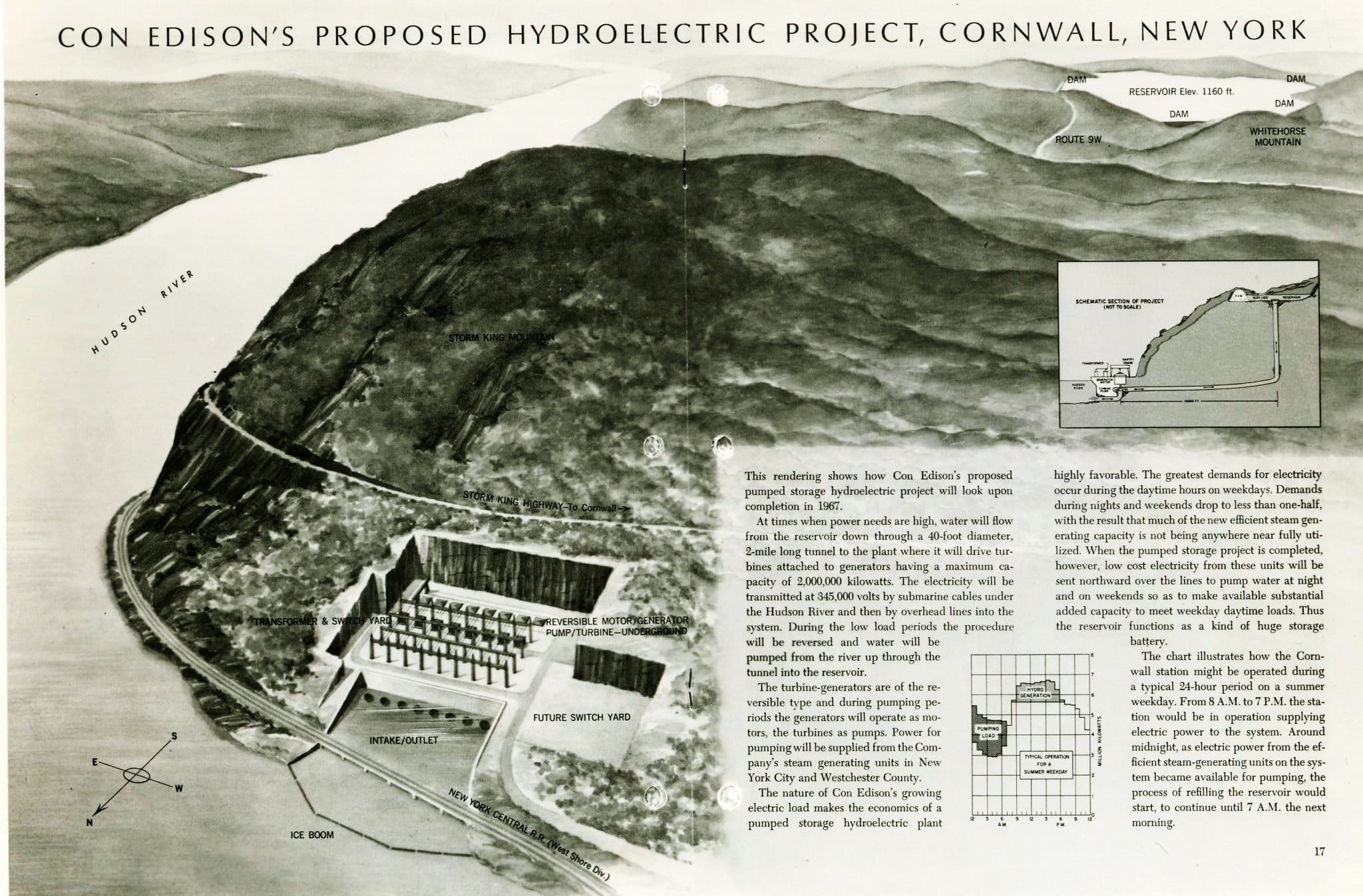
That’s when the Storm King hydropower plant, 60 miles north of New York City on the Hudson River, was proposed. A 2,000 megawatt pumped-storage facility, it would have been among the largest in the world and added more than 25% to Con Ed’s capacity.

“The Cornwall plant would do much to cut down the amount of air pollution in New York City… it would enable us to reduce the amount of coal and oil burned in New York and to shut down several hundred thousand kilowatts of our older steam electric generating units.”

M.L Waring, senior vice-president of Con Ed

A Plan With Many Supporters

The Storm King project was very popular in its host community of Cornwall and the nearby city of Newburgh. Village and Town citizens, officials and labor leaders were vastly in favor of the project for the benefits it would provide: economically, environmentally and in funding infrastructure improvements for their community.

Learn the full history of the Storm King controversy, the premature shutdown of the Indian Point nuclear power plant, and how they are intertwined with the decades-long environmental battle within the Kennedy family in this 2025 documentary by Fox Green.

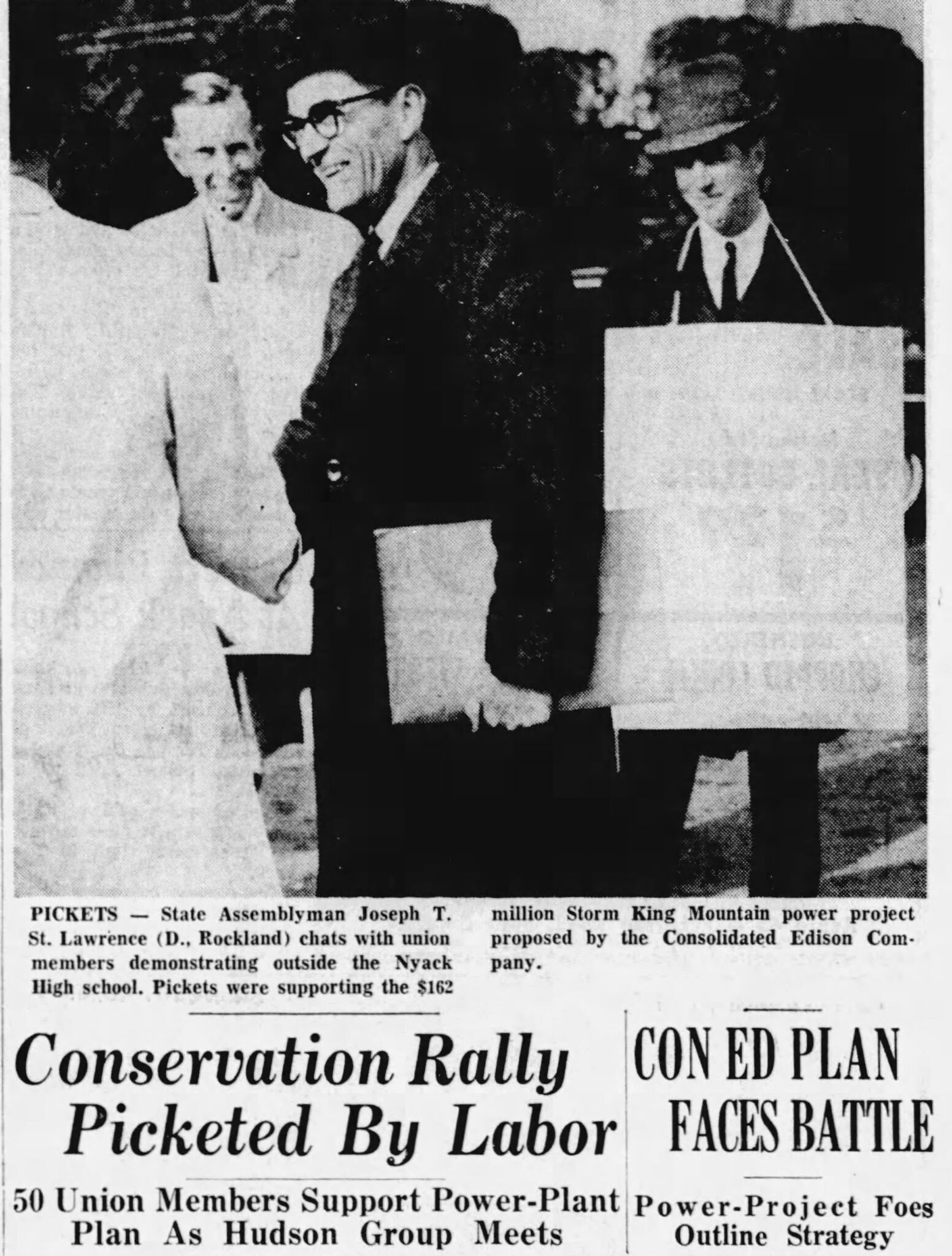
The biggest booster of the plant was the Village of Cornwall’s mayor, Michael Donahue.

Con Edison will pay annual taxes of $500,000, and with these increased revenues we shall be able to construct a new village hall, library, village garage, parks, a recreational center, nature trails, and municipal ski slopes.

Village of Cornwall Mayor Michael Donahue, 1964

Cornwall’s tax assessor, Wesley Rowland, estimated that the $400 million facility would contribute approximately $100 million to the town’s existing $132 million tax base. It was an enormous boost for a community of only 10,000 residents.

In nearby Newburgh, the struggling city had just gone through a vicious multi-year welfare crisis. A $165M industrial development project just five miles away was needed to “bolster its depressed economy, to provide employment, and to add stimulus to the rebirth of Newburgh.”

Organized labor also stood firmly behind the Storm King project, viewing it as a rare chance to bring long-term, well-paid employment to a region suffering from chronic underdevelopment. Construction unions, engineers, and utility workers all testified in support of the hydroelectric plant, emphasizing jobs, economic stimulus, and the project’s environmental compatibility.

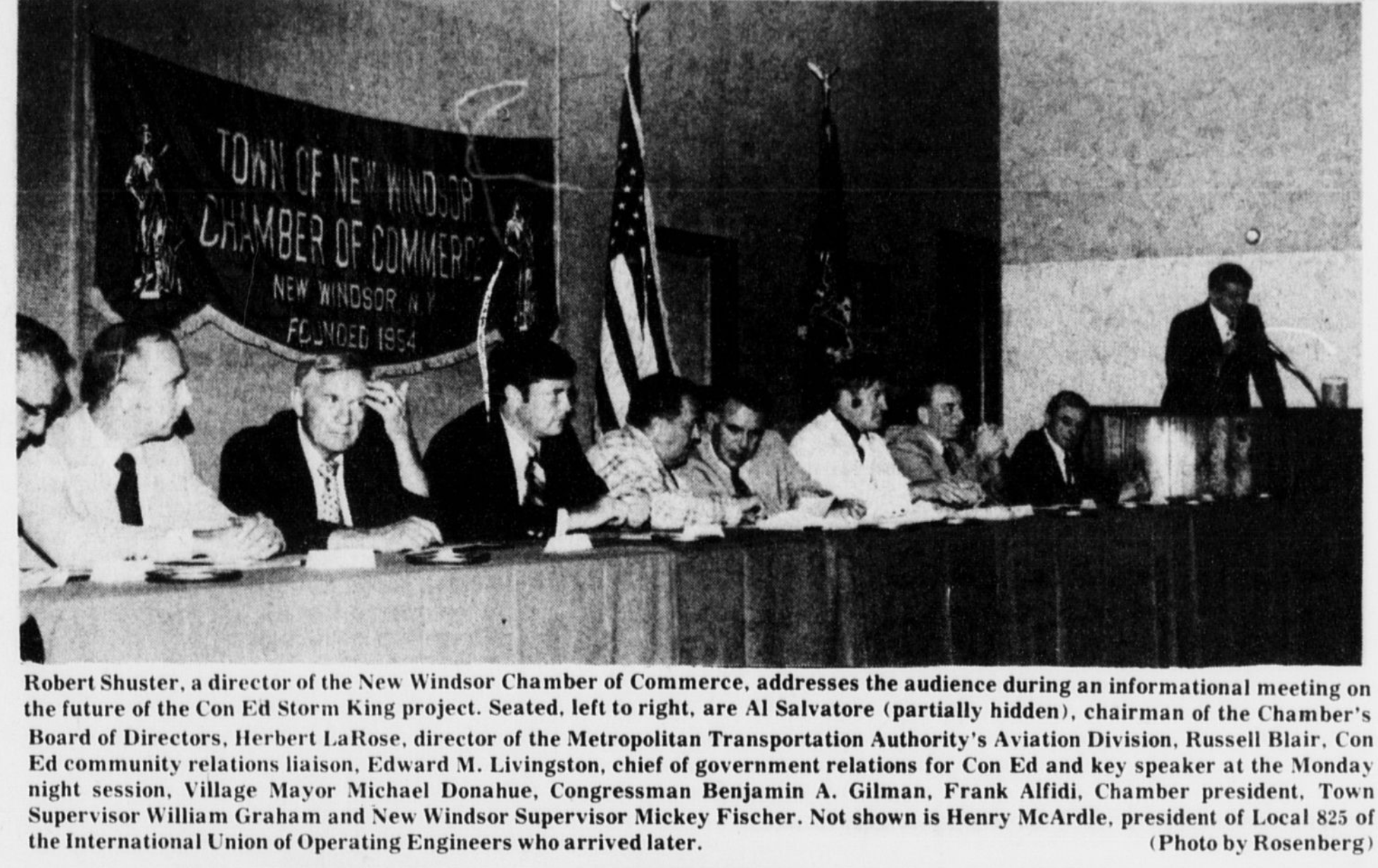
Henry P. McArdle, business representative of Local 825 of the Operating Engineers Union, said the plant would offer years of steady employment.

“This would [be] long-term employment for these men,” he said. “There are few jobs for men in the area.”

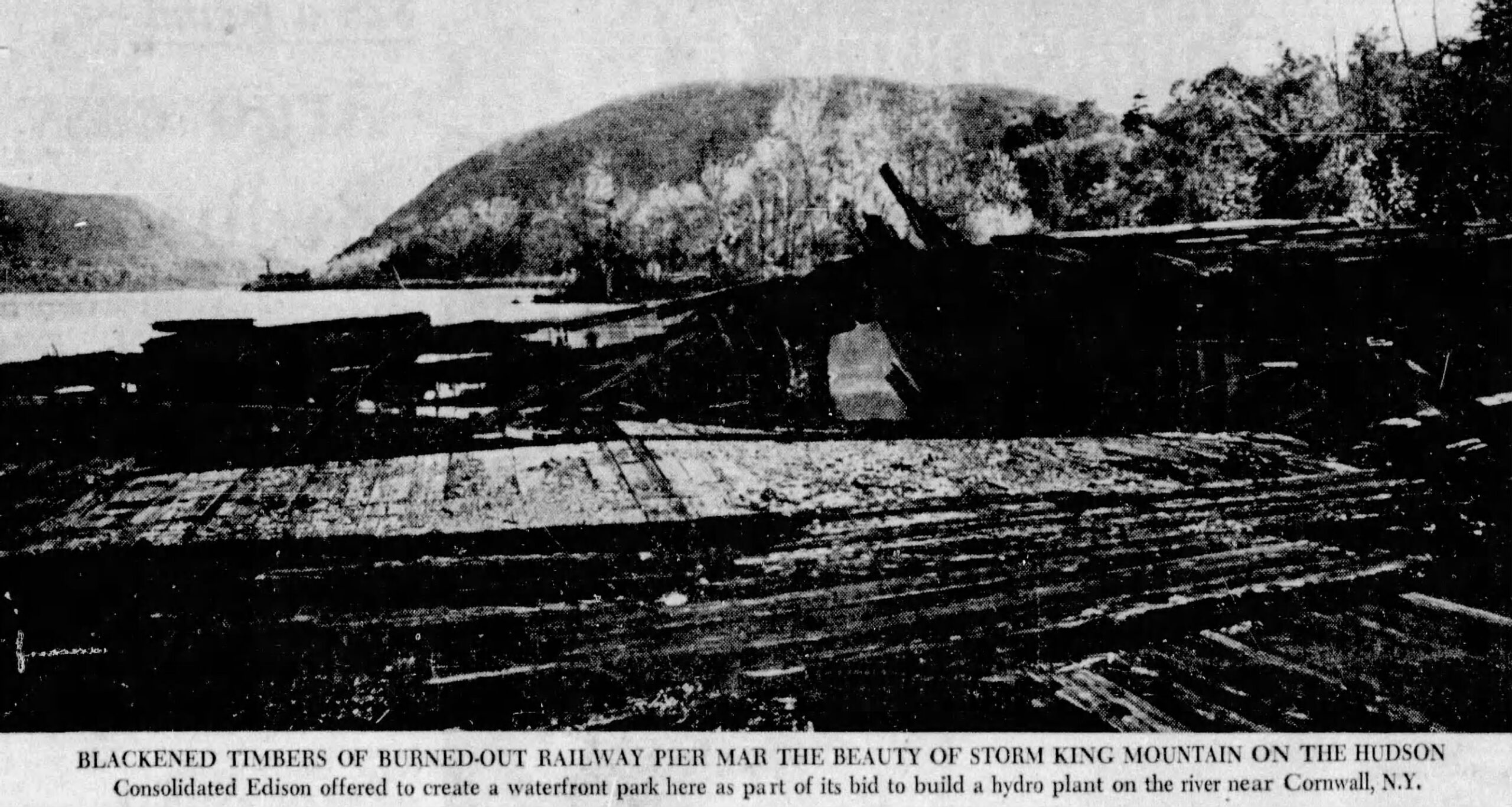
Con Edison also offered to clean up the waterfront in Cornwall, which was littered with industrial waste. The Cornwall Local reported that 1,700 people signed a petition in support, with only 100 opposed.

The Opposition: From Aesthetics to Fish

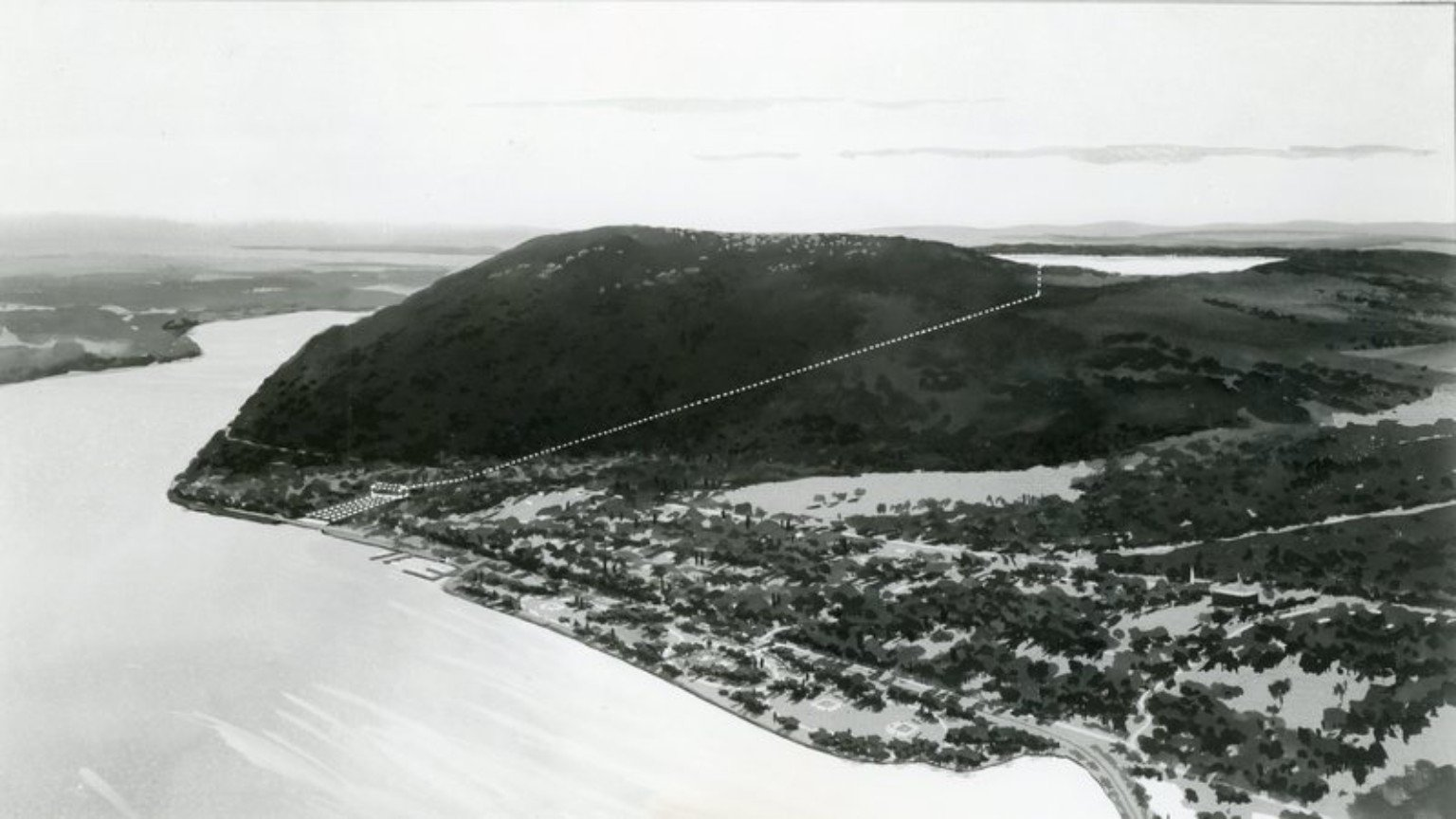
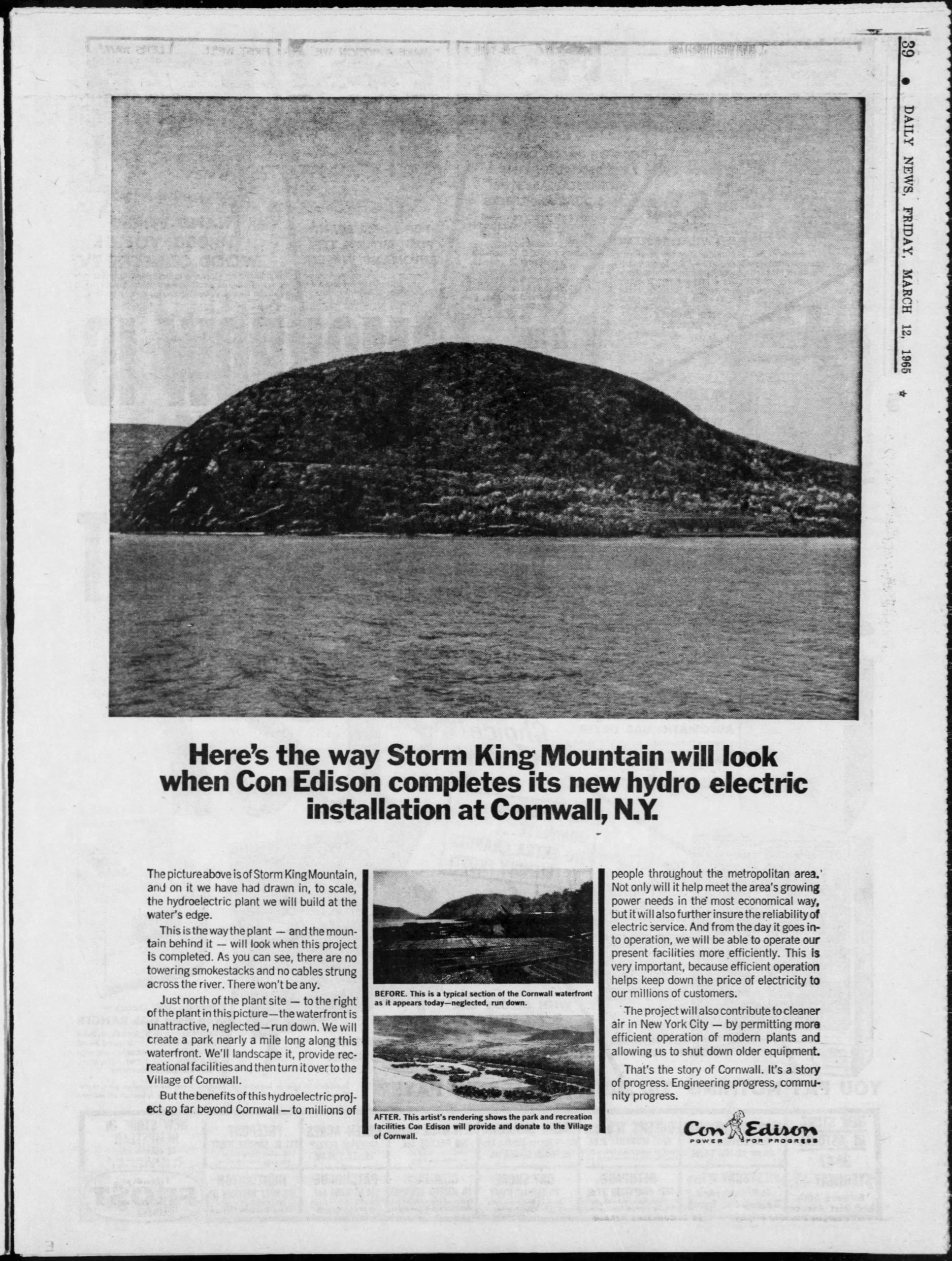
Initial designs for the facility had transmission lines running across the Hudson River and a small but noticeable intake area on the waterfront. In an early flyer about the plant, Consolidated Edison zoomed in on the design rendering to show detail, which gave the false impression that the project was going to swallow the mountain whole. 

“An artist’s rendering… showed the side of the Mountain cut away, leaving a gash… It was this illustration, in particular, that roused lovers of the Highlands to action.”

Albert Butzel, 2014

New renderings were quickly created, but it was too late. The original is the one that was plastered everywhere.

A group of “old money” Hudson River families saw the project as a threat to their legacy of conservation efforts in the region. Several of them were clustered across the river and to the south in Garrison, NY.

“From a very early point, diehard opponents of Con Ed’s plans would refuse to see the project in isolation; instead, they would come to view it as a harbinger of the industrialization of the Hudson River valley. Perhaps more importantly, many environmentalists, feeling overwhelmed at the changes they had witnessed during their lives, developed a militant, winner-take-all attitude when it came to land-use struggles. 

Carl Carmer [took]… a definitive stand: ‘It is my conviction that those who would destroy the beauty of our landscape should be fought off, not appeased. Appeasement is a postponement and if we are to preserve the landscape of the America we have come to love, postponement is the equivalent of complete surrender.’”

Robert Lifset, Power On the Hudson, 2014

Alexander Saunders was one of the leaders of the opposition to the plant. From his estate in Garrison, he said “we don’t feel this is the right area for industry. Of course, there are a lot of people on the welfare rolls in Newburgh, but as a businessman, I can tell you it doesn’t represent a very high calibre for a work force… the ideal land use for this area should be for recreation for people from New York City.”

Saunders was the chairman of the Scenic Hudson Preservation Conference and the Hudson River Sloop Clearwater organization started with a party at his house.

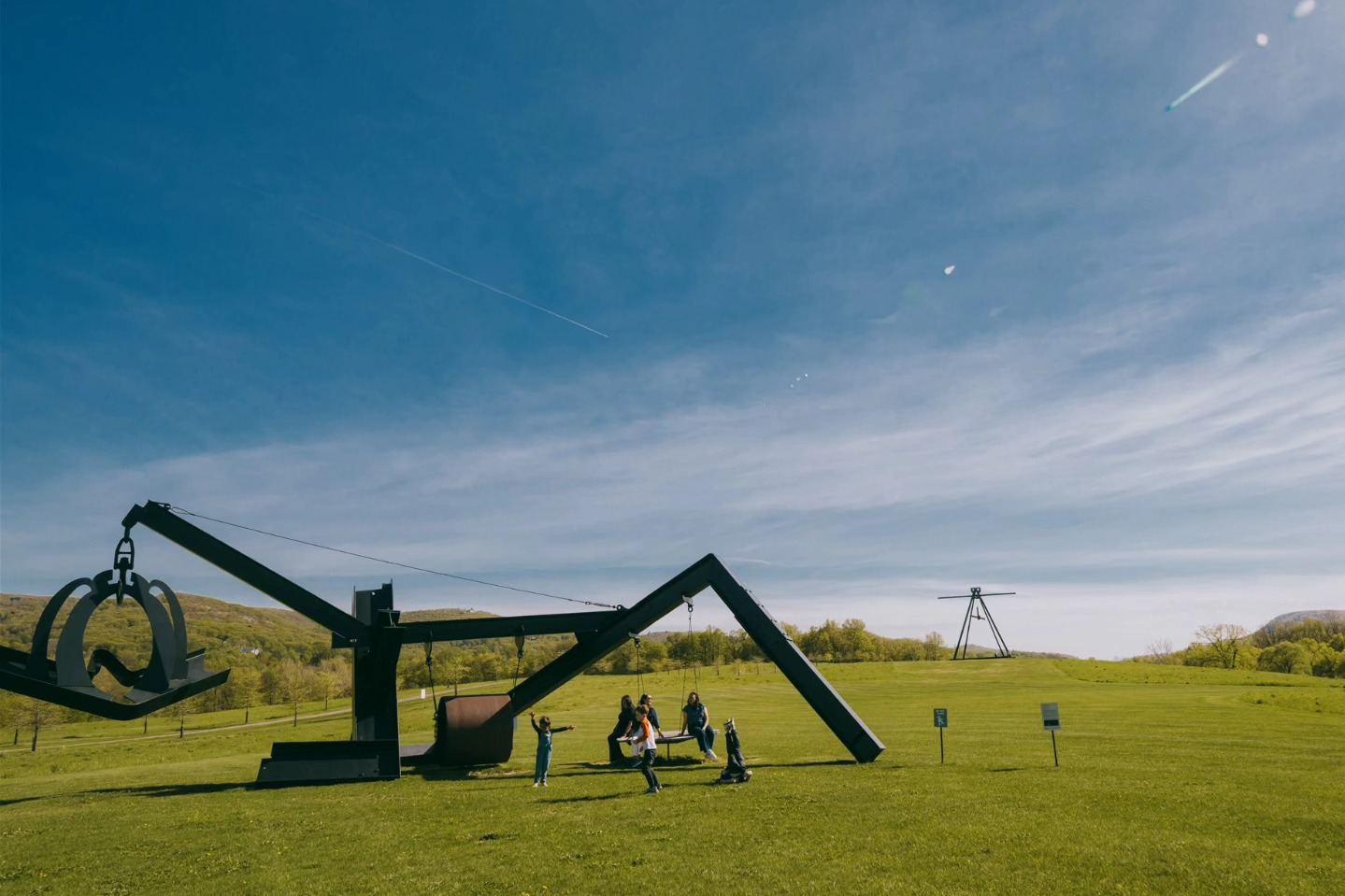
Today, the name “Storm King” is synonymous with an outdoor post-modern art museum beloved by day-trippers from New York City.

For these new preservationists, the Storm King battle was not about securing improvements or concessions; it was about fighting an indefinite war against industrial society in all its forms. Once it was clear that the plant would be virtually invisible on the Hudson River and an aesthetic argument would be impossible, the activists seized upon the idea of fish and fishermen being affected by the plant.

This strategic pivot was led by Bob Boyle, the future mentor to Robert F. Kennedy Jr., in his sensational 1965 Sports Illustrated article, “A Stink of Dead Stripers.” Writing with a hysterical verve, Boyle abandoned the dry legal terrain of viewshed arguments and plunged instead into a lurid story of ecological doom, spinning a pile of decomposing fish near the Indian Point nuclear plant into a casus belli for total war over Storm King.

“Perhaps, ironically, the Hudson River, the living river, may yet be saved by dead fish long thought buried in an obscure dump.”

Robert Boyle

After publishing the article, Boyle met with two Scenic Hudson leaders, and congratulated them for their ongoing legal case against the plant. 

“He wanted them to know that the Hudson River in the vicinity of the Storm King plant was one of two principal spawning grounds for America’s Atlantic Coast striped bass population… “The striped bass spawn here,” Boyle said, “and it’s a very important area for larvae and plankton, and the pump storage plant will suck up the eggs and young.” [Scenic Hudson co-founder] Duggan recognized that this was the issue that could win the case. She rose with a gleeful smile and proclaimed, “They’re going to kill the fish! They’re going to kill the fish!” She was so excited, recalls Boyle, “It was like Churchill hearing Pearl Harbor had been bombed.”

John Cronin, Robert F. Kennedy Jr., The Riverkeepers, 1999

This strategic pivot was also noted by Con Ed:

“[The opponents are] still not satisfied; they now purport to espouse seriously a whole series of objections based on what will surely be shown here to be insupportable, far-fetched and exaggerated theories of disaster to flora, fauna, dikes and water supplies. One opposing witness has even taken the desperately extreme position that the plant should not now be built underground and invisible, the witness will know it’s there.”

James O’Malley, Con Ed Chief Counsel, 1966

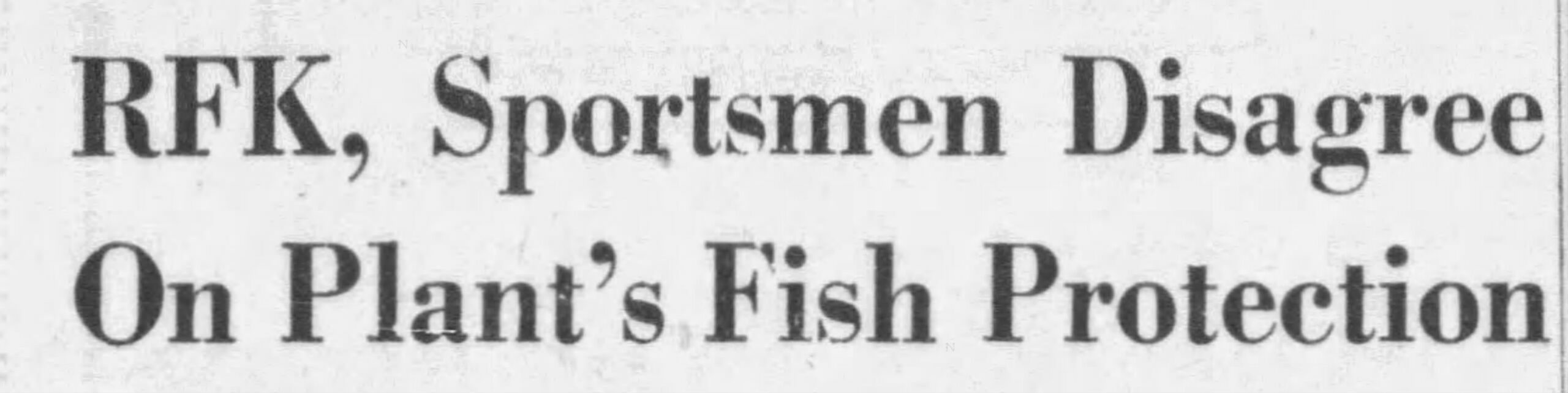
This extremism was even noted by New York Senator Robert F. Kennedy, who testified to Congress that he “cannot believe that our marine biologists are unable to offer assistance in meeting this problem on the Hudson. I cannot believe that a solution to the problems with the Storm King project…. cannot be found.” 

He also noted that Con Ed had offered to build a screen shielding the intake pumps at Storm King, and believed a solution could be found to the fish life questions.

Alfred Perlmutter, a professor of biology at New York University said that “one active sport fisherman would have as much effect on striped bass egg larvae” as the project would.

It was the romanticism of fish and fishermen on the Hudson River that stretched out an open-and-shut case over aesthetics into something that could go on indefinitely. Environmental non-profits spawned like fish in the Hudson; the old guard of the Hudson River Conservation Society led to Scenic Hudson, which led to the Rockefeller-supported Clearwater, the Ford Foundation-supported National Resources Defense Council, the Rockefeller/Harriman-led Hudson River Valley Commission, and the Hudson River Fisherman’s Association, which soon morphed into the Robert F. Kennedy Jr.-led Riverkeeper group.

The Death of Storm King 

Storm King was a David & Goliath fight, but it’s quite possible that Con Ed was David and the old money hydra it faced was Goliath. By the 1970s, changes to the U.S. monetary system and interest rates meant that what was once a $150M plant was slowly turning into a $1B project, where the economics could never pencil out despite an ongoing energy crisis and multiple blackouts in New York City.

The financing was made even more difficult because the national response to the energy crises of 1970s was, as Jimmy Carter put it, to put on a sweater and turn the heat down. Con Ed could not rely on steady growth in electric demand to pay for the plant. Additionally, the plant became leverage for Con Ed in negotiations with environmentalists over building cooling towers at Indian Point nuclear plant.

The Village of Cornwall’s Mayor Donahue never stopped advocating for the plant. “They’ve had conservationists all the way from Australia talking about Storm King,” he said in 1973. “They never want to know what the local people think.”

In 1976, he continued: “We – the project supporters – contend that the Cornwall plant is in the public interest. We firmly believe that it would contribute substantially to the economy of this community, that it would enhance the preservation of scenic beauty and that it would enhance the preservation of scenic beauty and that it would not affect conservation of the river’s fishery.”

According to a Con Ed official, the construction of the plant would have supported a $35M annual payroll and employed 1,500 Orange County employees from eight county labor unions. 

A union workman, reacting to one of the endless delays in the project, was blunt:

“We are all bitter as hell. This whole controversy has been ginned up by outsiders. Why should I lose my job because some guy may not be able to catch his limit of striped bass off his pleasure boat?”

But after years of lawfare, the plant was killed in closed door negotiations in 1980 between Con Ed and 10 other organizations, mediated by Russell Train, former head of the EPA and Malthusian head of the World Wildlife Fund.

A Final “What If”

Today, the proposed alternative to the “Asthma Alley” power plants in New York City is to locate dangerous lithium-ion battery plants right inside major population centers, with a mandate to build six gigwatts of battery storage statewide by 2030. The peaker plants are still running.

The cognitive dissonance over energy and the environment that resulted from the Storm King case is almost too much to take in. The added air pollution, asthma hospitalizations, increased energy costs, and now, the desperate crunch for clean energy storage in New York State makes seeing the sordid affair as an “environmental” landmark utterly absurd.

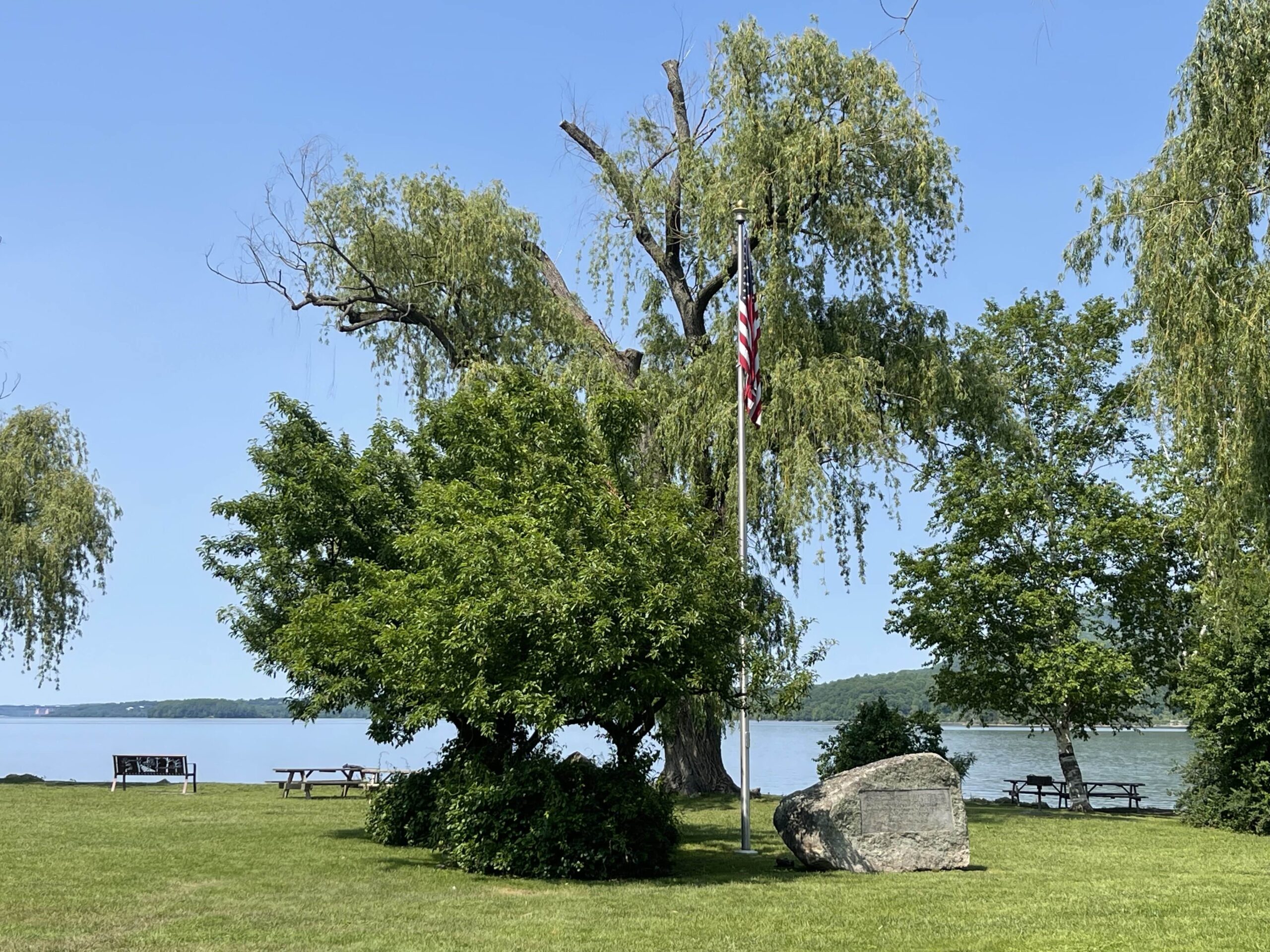
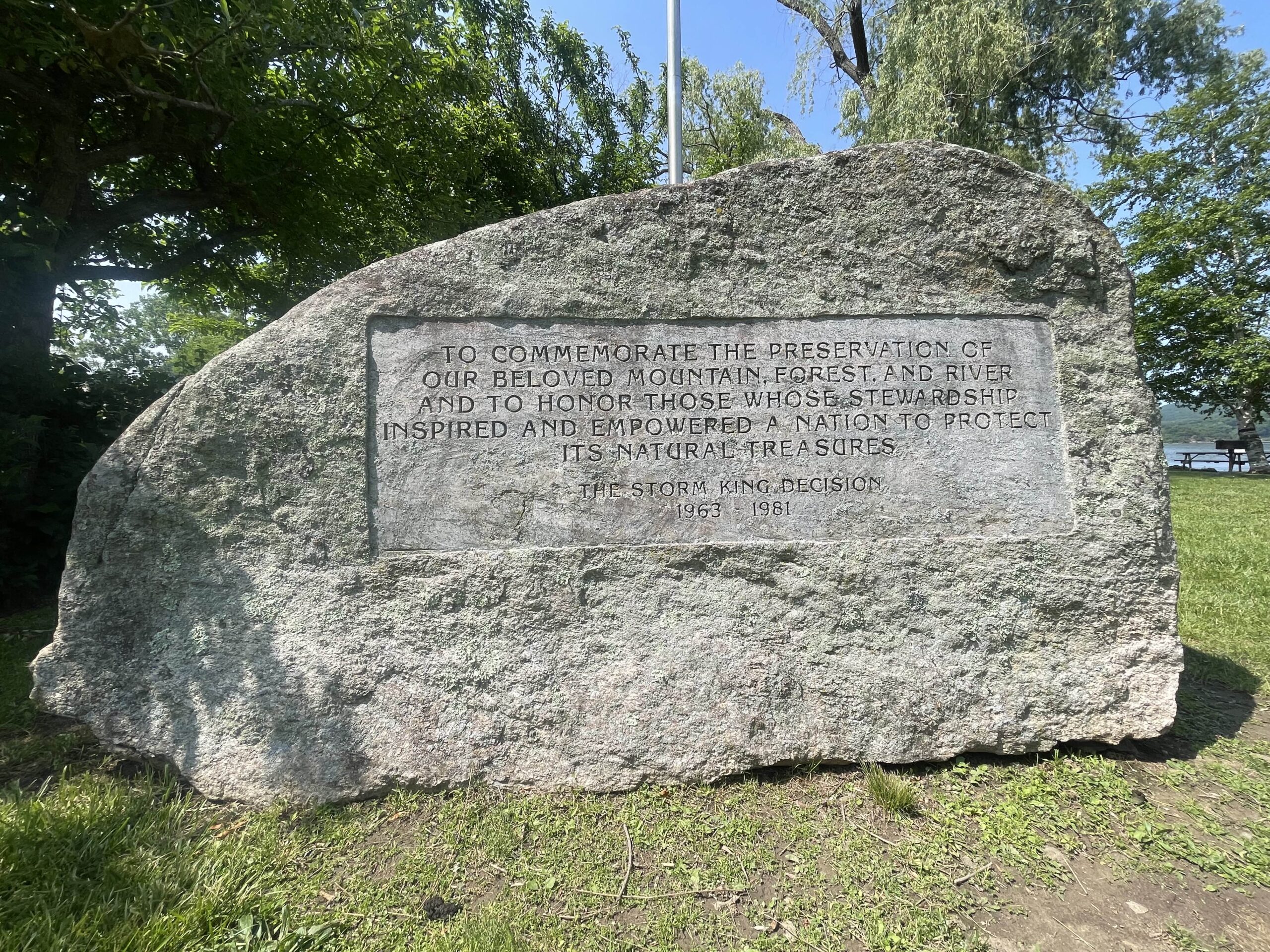
As for the good Mayor Donahue, he served as Cornwall’s beloved mayor for 28 uninterrupted years ending in the late 1970s. The lost promise of the Storm King plant was the great “what if” of his tenure, forever beyond his grasp. After the settlement, Con Ed donated land to the Village of Cornwall which was later dedicated as Donahue Memorial Park, in his memory. Approaching the park, you might only notice one plaque:

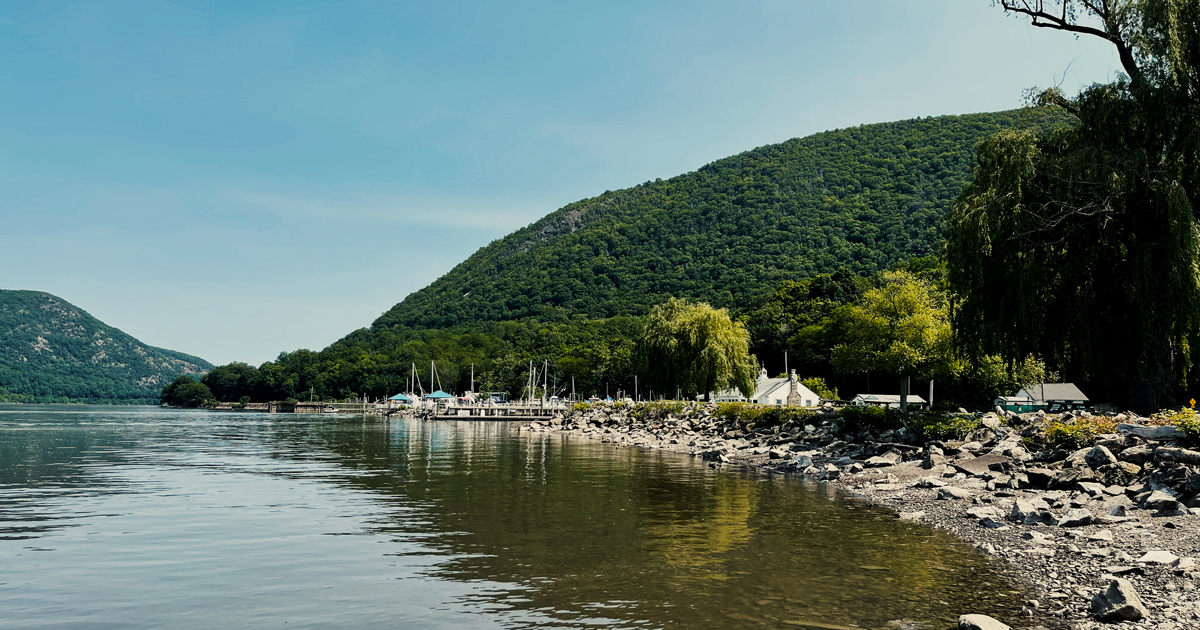
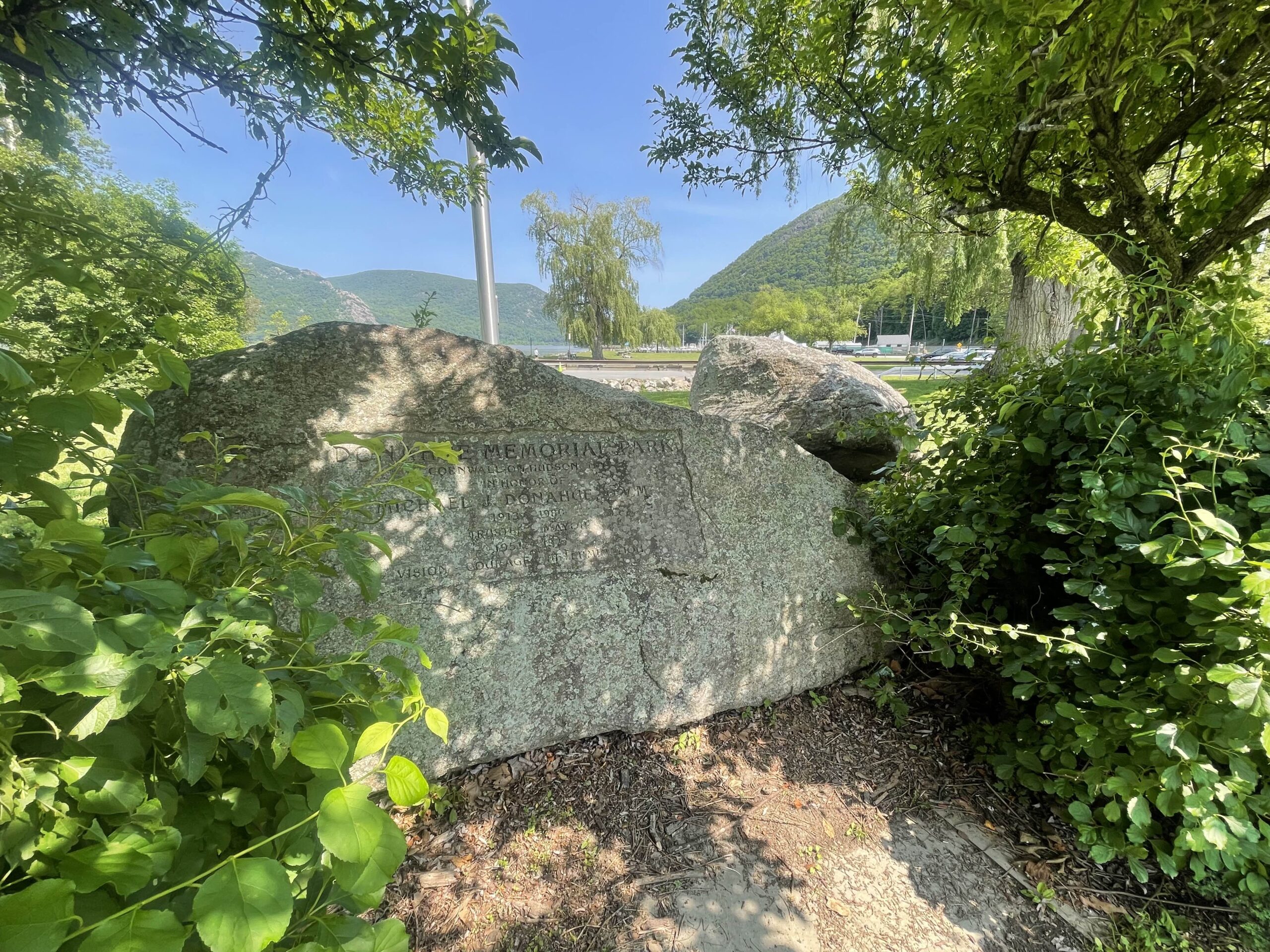
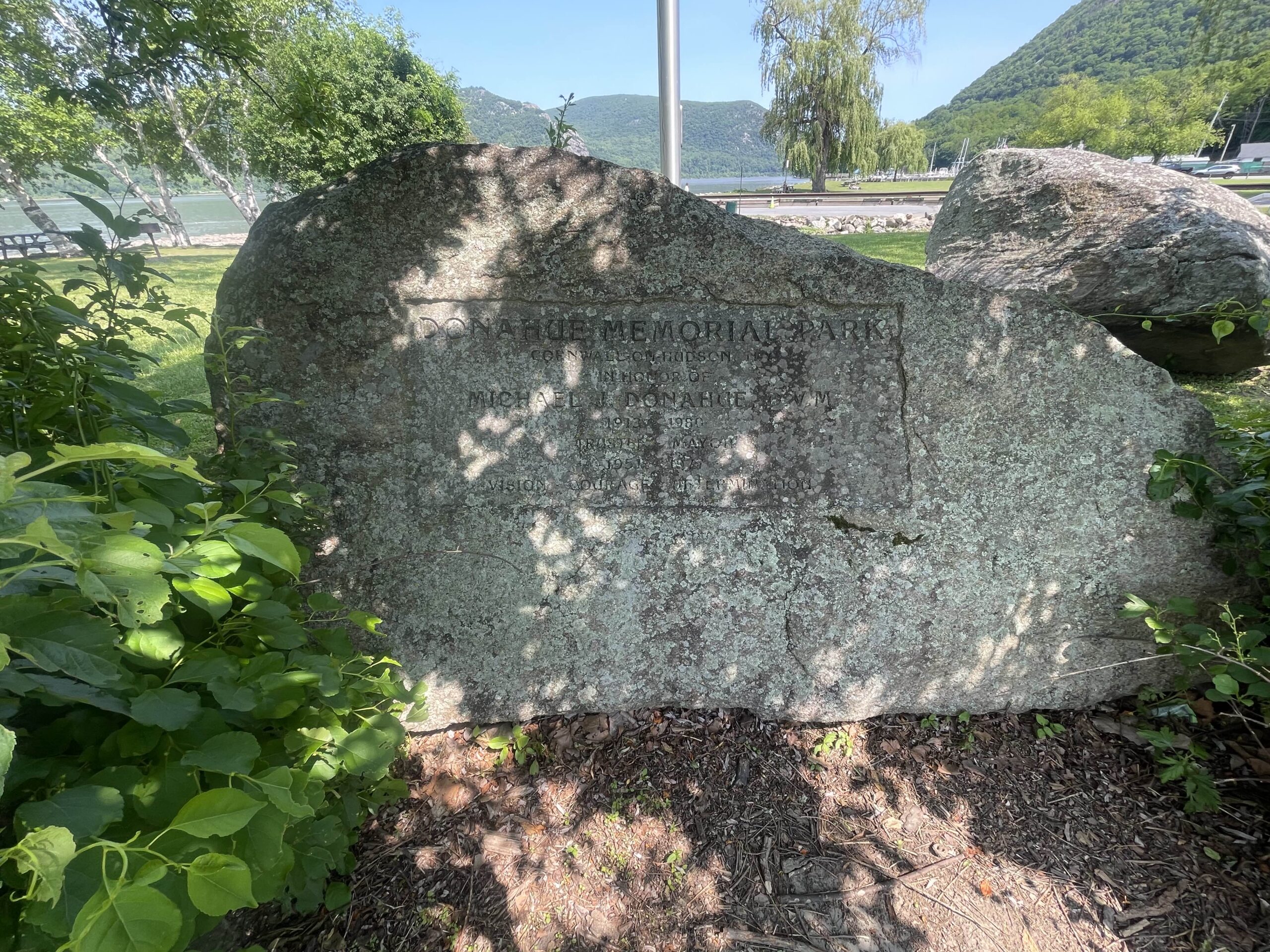
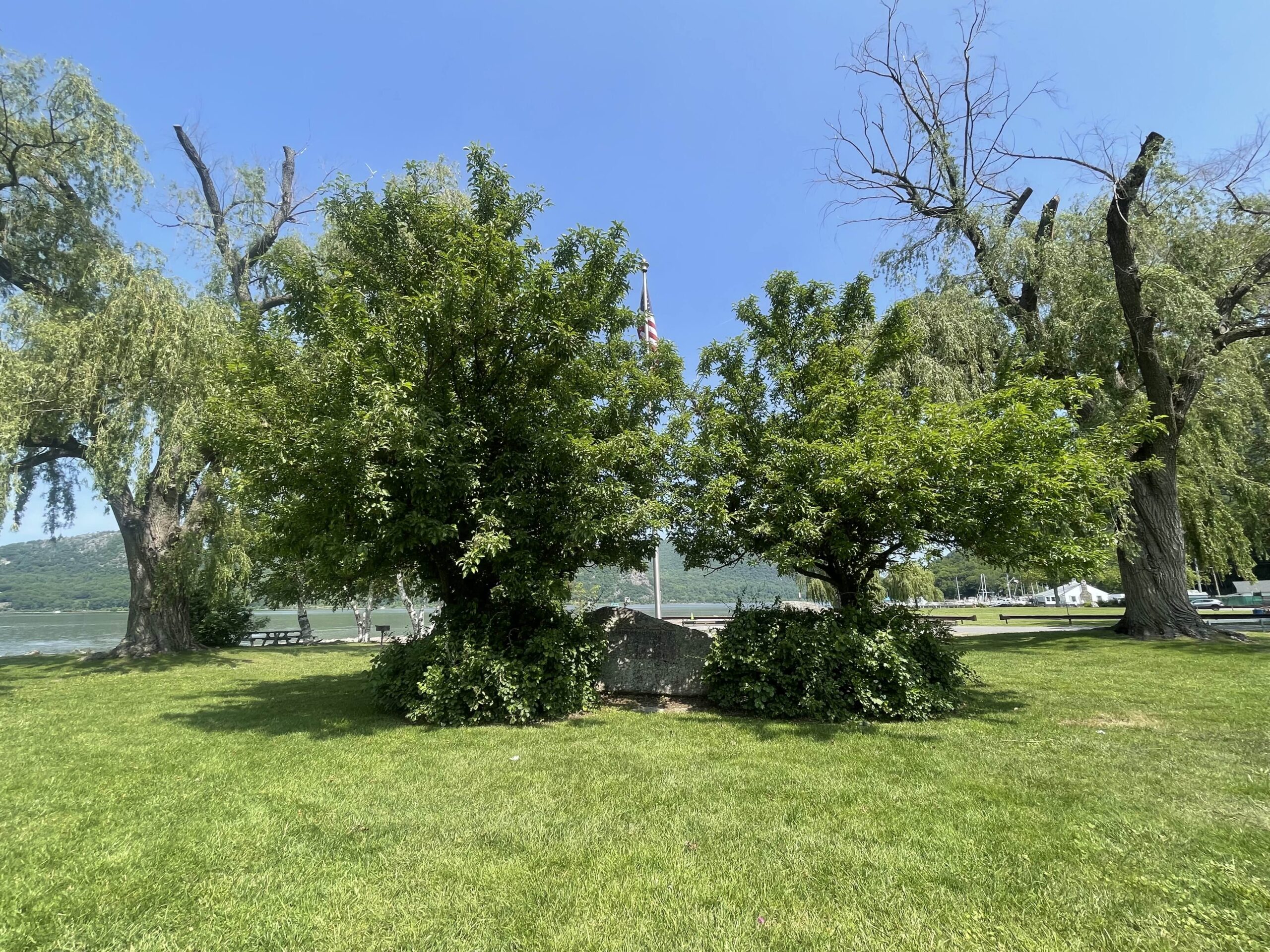
If you move to the left, buried behind foliage, you’ll find a second plaque dedicated to the memory of Mayor Donahue. You can see the faded tribute to him below, with Storm King Mountain in the background to the right:

In 2009, the more prominent plaque was added with much controversy. The addition was protested by Donahue’s surviving daughters, as it commemorated the elite environmentalists that Donahue fought against for 15 years.

The plaque faces outward toward Storm King Mountain, gleaming and well-maintained. Behind it, Donahue’s original plaque is nearly hidden—faded, weather-stained, and shrouded by overgrown foliage, like the memory of the future he once fought for. It maybe be obscured—purposefully hidden from the light of day—but Donahue’s plaque still stands, like the truth, waiting to be rediscovered.

In a sharp rebuke to the Jeffersonian-DSA model of 100% renewables under the BPRA, New York signals a return to the Hamiltonian-FDR vision of state-directed infrastructure for industrial growth and prosperity.

This week, Governor Kathy Hochul announced that the New York Power Authority will pursue at least one gigawatt of new nuclear power, marking the first major state-led nuclear development effort in a generation. It’s a small step, but a decisive one. And it confirms what the New York Energy Alliance and our allies have argued all along: true energy policy means production, not restriction. Growth, not rationing. Hamilton, not Jefferson. 

For years, energy policy in New York has been dominated by a strain of neo-agrarian technocracy with the veneer of climate activism. It’s a dark mix of Andrew Cuomo’s political ambitions in the mid-2010s, combined with RFK Jr.’s anti-nuclear mysticism, Mark Jacobsen’s fuzzy climate math and Mark Ruffalo’s screams.

The Build Public Renewables Act (BPRA), backed by the DSA and green NGOs constituted in the so-called Public Power Coalition was its latest expression. It claimed to follow in the footsteps of FDR, but it really was an act of eco-sabotage against the grid that he helped build. It is a plan to destroy firm power, starve nuclear energy of public investment, and tie New Yorkers’ public infrastructure to the whims of the weather. 

This agenda would have used the power of the state to bully rural communities into trading farmland, forests, and viewsheds for seas of solar panels, while urban activists sneered about “bulldozing landowners.” But with Hochul’s nuclear directive, that premise has been rejected. By empowering NYPA to build nuclear, the state is reembracing what FDR called freedom from want, not through artificial scarcity, but through abundant, sovereign infrastructure.

“Translated into world terms,” FDR wrote, “that means economic understanding which will secure to every nation a healthy peacetime life for its inhabitants, everywhere in the world.”

The order affirms that public investment should be directed toward projects of scale, permanence, and sovereignty, breaking the degrowth priesthood that treated baseload power as blasphemy. New Yorkers understand that you cannot run a civilization, let alone reindustrialize it, on intermittent power.

This pivot is not just a policy shift. It’s a philosophical one.

Jeffersonianism has always viewed man as a liability to be managed. It sees energy as a problem to be solved with behavioral nudges and shrinking footprints. 

Hamiltonianism, by contrast, views man as a creative, transformative force made in the image of God. It believes in using science, credit, and statecraft to uplift humanity, not to manage its decline. It builds nuclear plants, hydro dams, and transmission lines. It powers productive industry. It sees energy not as something to be trimmed, but as the lifeblood of independence, culture and prosperity.

FDR was a Hamiltonian. He didn’t see state-directed infrastructure as a utilitarian project, but an American one: to electrify farms, power factories, and erase the line between town and country. He believed in projects that could “transcend mere power development,” “distribute and diversify industry,” and help lead “logically to national planning… involving many states and the future lives and welfare of millions.” He believed in projects that could “touch and give life to all forms of human concerns.”

That spirit didn’t end at the water’s edge. FDR saw the TVA and the St. Lawrence-FDR Power Project in Massena, NY not just as domestic triumphs, but as models for the world, using public credit and state planning to build lasting peace and productive international development. He knew the alternative to such planning was collapse.

In New York Energy Alliance’s public testimony, policy statements, and media appearances, we have called for a real energy agenda, which includes NYPA returning to its roots and leading the nation in building modern infrastructure that serves the general welfare.

Today’s announcement suggests the tide is turning. Hochul’s directive signals that the American System is alive: long-term public investment in high-productivity infrastructure, aimed not at managing decline but expanding the human horizon.

We know one reactor is not enough. The road ahead is long, and the resistance, from the same anti-nuclear mystics who sabotaged Indian Point, will be fierce. And as trendy as it might be, this moment does not call for blind “abundance” utilitarianism, but as FDR put it, an “enlightened administration” that can “adapt existing economic organizations”, like NYPA, to the service of the people.

So yes, this moment matters. Because it proves the dam is cracking. The ideology of managed decline is faltering. The anti-human energy consensus is losing its grip. And in its place, something older and nobler is beginning to stir: It’s time to build.

Utilities, whether investor-owned or publicly controlled, must serve everyone in the community. And the Hudson Valley is far more than just a leftist environmentalist enclave—it’s home to working families, small businesses, and industries that depend on reliable, affordable energy to survive.

But Assemblymember Sarahana Shrestha’s Hudson Valley Power Authority Act (HVPA) is not a pragmatic energy policy—it’s an ideological experiment.

In an inauspicious preview of what “energy democracy” will look like, Shrestha has blasted any opposition to her Hudson Valley Power Authority Act agenda as “misinformation.”

But the real misinformation is her refusal to address the actual consequences of her bill: using the crisis of rising energy costs to justify a hostile takeover of Central Hudson, one that could increase costs, disrupt service, and impose a rigid ideological agenda that prioritizes wind and solar over affordability and reliability. Her bill treats 90,000 natural gas households and businesses as an endangered species—not customers whose needs should be met.

While Assemblymember Shrestha invokes Franklin Delano Roosevelt to support her arguments, she ignores a fundamental truth: FDR believed in abundant, affordable energy as a foundation for economic growth. When he advocated for public power in 1932, he was backing the creation of the Tennessee Valley Authority (TVA)—a model that thrived because it embraced a balanced energy mix, including nuclear, coal, natural gas, and hydro. TVA never pursued energy austerity—Shrestha does.

Shrestha’s rebuttal fails to address the following indisputable truths:

  • Massena Electric customers still worry about their bills despite Shrestha’s claim in September that “no one worries about their bills anymore.”
  • The informal evaluation of Central Hudson’s acquisition shared by Shrestha suggests potential shortfalls in servicing debt could be covered by either: a surcharge on ratepayers (i.e. higher energy bills) or state and county budgets (taxpayers). Either way, residents and businesses will foot the bill.
  • Public officials are being pressured to unconditionally endorse the HVPA without any verified cost-benefit analysis or rate comparison between HVPA or Central Hudson.
  • The HVPA Board and Observatory are stacked with politicians, activists and academics – not engineers or grid operators.
  • Before a single meeting of the “democratic” HVPA Board and Observatory can be held, the HVPA bill has already mandated a study to set a timeline for the “phaseout” of natural gas infrastructure.
  • Actually existing public utilities are blaming Shrestha’s “Build Public Renewables” Act for threatened rate hikes. (Will they be attacked by Shrestha for spreading misinformation?)
  • Public power utilities regularly renegotiate PILOTs; there is nothing binding that says that tax payments will remain equal to what Central Hudson pays now in perpetuity.
  • The HVPA campaign was crafted before input was sought from the IBEW Local 320, which represents hundreds of Central Hudson workers. Five months after the bill was introduced and publicized, an email blast was sent out asking if any DSA followers knew anyone who worked at Central Hudson.

Hudson Valley Residents Deserve Honest Answers

Hudson Valley residents and businesses don’t need blind ideology masquerading as an energy cure-all. They need representatives who are willing to tackle the underlying causes of high energy prices, shifting away from the destructive course that was set by the climate and energy policies of Andrew Cuomo and Robert F. Kennedy Jr. in the 2010s, and toward the truly anti-entropic and abundant vision of FDR. The HVPA remains an experiment that is too risky and costly to be conducted on our dime.

If New York’s climate laws are to be believed, our state must reach net zero emissions by 2050. According to the most absolutely optimistic official estimates, it will cost about $15B a year, or $375B to get there (while the majority of the benefits aren’t expected to directly help New Yorkers). The $375B will come from some combination of higher utility bills, taxes, bond measures, or private investment.

There isn’t a consistent county-by-county accounting of how many emissions are generated where, but three counties in the Mid-Hudson Valley have quantified what their total, community-wide annual emissions are: Dutchess, Orange and Ulster County.

What are New York State’s total emissions?

Depending on the year, the total annual GHG emissions for NYS are around 350 MMT CO₂e.

How many emissions come from the Mid-Hudson Valley?

According to their most recent reports (numbers are in million metric tons of carbon dioxide equivalent):

Dutchess County: 2.6 MMT CO₂e
Orange County: 5.9 MMT CO₂e
Ulster County: 2.1 MMT CO₂e

Total: 10.6 MTC02e

By dividing the regional 10.6 MMT CO₂e figure by the statewide 350 MMT CO₂e figure, we reach the conclusion that the Mid-Hudson Valley is responsible for about 3.04% of New York State’s total emissions.

How much will it cost for the Mid-Hudson Valley to reach net zero?

Assuming a total emissions figure of 10.6 MMT CO₂e, and a total price tag of taxes and consumer costs of $375B, we can deduce that it will cost the residents of the Mid-Hudson Valley $11.4B to decarbonize by 2050.

Dutchess County: $2.79B
Orange County: $6.32B
Ulster County: $2.29B

Indian Point Closure Added CO₂ Equal to the Mid-Hudson Valley’s Entire Annual Emissions

According to various estimates, the premature closure of Indian Point Nuclear Power Plant in 2021 led to an increase in emissions by anywhere from 8 to 15 MMT CO₂e a year, due to the emissionless nuclear energy being replaced by new natural gas plants in Middletown and Dover Plains.

The average estimate is the closure resulted in an increase in emissions of roughly 11.5 MMT CO₂e, which is 0.9 MMT CO₂e more than the entire emissions put out by all of the Mid-Hudson Valley.

What should New York do with this information?

Over the last two years, we have written about many of the consequences of New York’s irrational energy policies, including:

Sign up for our newsletter!

To help foster energy affordability and reliability for New York families and businesses, we at New York Energy Alliance reiterate our call for:

  • A comprehensive review and reassessment of the CLCPA’s goals and implementation strategies.
  • Transparent and accurate cost estimates to inform the public and ensure financial accountability.
  • A realistic plan that explores all viable energy sources, especially the expansion of nuclear and hydro power, to ensure reliable and affordable energy for all New Yorkers.

We Want You to Tell NYPA Your Thoughts


The New York Power Authority has wrapped up its formal conferral process and has moved to hosting public hearings on its planned implementation of the Build Public Renewables Act (BPRA). The green’s, as always, are pushing public comments to try to make their unrealistic and expensive plan seem more popular than it actually is. We at NYEA would like you join us in counterbalancing this narrative. There are both in-person and online hearings left to attend.

At the online evening session, we will be reiterating what we said in the latest round of the conferral process; that NYPA should focus on building a reliable and affordable grid for all New Yorkers. NYPA cannot make the impossible possible. We will also highlight that true community interest should be at the heart at whatever NYPA decides to do. Our friends at the Stop Energy Sprawl coalition have noted that NYPA has already partnered on unpopular renewable development projects in order to bail them out. This feels only a few steps away from NYPA using eminent domain authority to push projects through (though so far NYPA has insisted it has no interest in using such powers at this time).

We encourage you to make your voice heard. If you are unable to attend any of the sessions please write to NYPA here.

This week, The Future Energy Economy Summit was held in Syracuse. The event was a long time coming: it’s the first step in New York State acknowledging that the climate policies of Andrew Cuomo and the anti-nuclear mysticism of Robert F. Kennedy Jr. and co. are incompatible with an electrified, reindustrializing, and clean future.

The delusions of a depopulated, deindustrialized New York State powered by sunshine and gentle breezes are slowly being replaced by reality: New Yorkers want good jobs, affordable energy and viewsheds that aren’t dotted with toxic solar panels and wind turbines.

That’s going to mean that natural gas infrastructure and extraction are not tomorrow’s stranded assets, but important investments in our future.

And it’s going to mean what was once unthinkable: that the Promethean fire of nuclear energy development, as dreamt of by presidents like John F. Kennedy and Dwight Eisenhower, will be unshackled from the tight grip of “no-growth” environmentalism, represented by dozens of groups who are, by their own logic, now climate deniers arguing against emissionless energy:

Homeowners and businesses are experiencing the first price shocks of the Climate Leadership and Community Protection Act (CLCPA), and while utilities like Central Hudson and National Grid are the popular scapegoats for now, it won’t be long before the true underlying policies are identified and re-written.

Our recent analysis of “day-ahead” prices since 2017 found that New York communities that have emphasized intermittent renewables like solar and wind have the most expensive energy in the state, while communities in Western and Central New York that rely on nuclear and hydro have the cheapest energy in the state.

It’s not a question of state ownership vs. private monopoly; it’s a question of production and ideology. Does a prosperous future involve abundant, 24/7 energy, or energy that relies on the weather?

New York Energy Alliance was pleased to join Stop Energy Sprawl, Nuclear New York and New York Energy and Climate Advocates in a join statement calling for sensible energy policies before the conference. We also were featured in a Democrat & Chronicle article by journalist Thomas Zambito in the aftermath:

On the streets outside the Syracuse Marriot Thursday, anti-nuclear groups carrying signs reading “Nuclear No” held a rally to challenge Hochul’s newfound interest in nuclear power.

“Our Governor is wining and dining dirty energy snake oil salesmen when she should be doubling down on clean, renewable energy buildout — New Yorkers are having none of it,” said Laura Shindell, the state director of Food & Water Watch, one of the leaders in the 2014 effort to get the state to ban natural gas fracking. “Our climate future is at a crossroads, and Hochul is perilously close to taking a dangerous step in the wrong direction.”

Joining Shindell was Cornell University professor Robert Howarth. “She (Hochul) does unfortunately have this infatuation with nuclear power, this distant shining object that‘s way off there somehow that she thinks might help as part of the solution,” Howarth told the crowd. “We need to tell her she’s wrong.”

More than 150 groups opposed to nuclear power signed a letter urging Hochul to recommit to deploying wind and solar power to achieve the state’s climate goals.

They were countered by the New York Energy Alliance, which supports an all-of-the-above approach to solving the state’s energy issues, using nuclear power to complement natural gas and hydropower.

“The Governor is soft-launching the inevitable,” said Brian Wilson, a leader in the alliance. “The last 50 years of New York’s energy and environmental policies have been short-sighted and destructive for our state, and drastic changes are needed before she and the Democrats are left holding the bag. We cannot electrify everything and re-industrialize on solar panels and wind turbines. Professors and activists cannot keep the lights on, but nuclear, natural gas, and hydro can.”

NYEA NYPA Response


Recently, NYS has admitted that its unreachable energy goals are unreachable (see “CES Biennial Review Report” 07/01/2024). This lead to the expected calls from anti nuclear green NGOs for NYPA to speed up its implementation of the BPRA to meet the renewable energy “shortfall.” NYPA seems to be feeling this pressure, as they have reached out to their conferral participants, of which NYEA is one (pg. 19), on feedback on the process thus far. The questions posed, and our response, is listed below.

  • Please share your thoughts on the State’s progress toward CLCPA goals.
  • Please share your thoughts on how NYPA can or should support CLCPA.
  • Please share your thoughts on what NYPA is already doing to support CLCPA.
  • Do you have anything else you would like to share for the record?

Thank you for reaching out to us for our opinion on this matter. Our answer to the stated questions is informed by the recent interview given by your VP of Renewable Project Development and the recent PSC report that states NY’s CLCPA 2030 renewable goal will not be met. This announcement has spurred many to call on NYPA to use its new authority from the BPRA to fill this gap.

We at NYEA feel that NYPA is moving at a correct pace, and that no pace is possible to reach a goal that was from the beginning unrealistic. NYPA has set a timeline and is working to understand the best way for it to use its unique advantages to produce renewable energy in New York while being mindful of public perception. From our first conversation with NYPA, we feel NYPA does not want to ram rod development through localities that do not want it, and its process thus far is indicative of that. As stated in the above mentioned interview, the BPRA does not force NYPA to step in if the 2030 goals are declared unreachable, as the bills most ardent supports try to characterize. To even attempt to do so will cause the public relations nightmare NYPA has wanted to avoid from day one.

Also, it should be made clear, NYPA does not own any renewable manufacturing capacity. It is affected by the same supply chain delays and cost overruns as any other developer. NYPA cannot magically make a turbine or panel appear, there absence a core reason for the delays.

NYEA maintains the same position that NYPA should look to re-enter nuclear generation, especially looking forward to the CLCPA 2040 goals. NYPA seems very willing to enter public-private partnerships, maybe one avenue could be partnering with NY’s last nuclear operator, Constellation, on a joint project.

With this most recent announcement, we believe the State should re-assess it goals and set ones that are achievable and serve the actual interests of New Yorkers: reliable, cheap, abundant electricity for all New Yorkers. As for NYPA, it should stay the course it is on until such time more sensible heads prevail. NYPA cannot perform miracles, it is too busy delivering electrons.

The New York Energy Alliance (NYEA), a grassroots organization dedicated to advocating for abundant and reliable electricity for New York State families and industries, commends New York State Comptroller Thomas P. DiNapoli for his recently released audit report, “Improved Planning Needed for New York To Achieve Its Clean Energy Goals.” The report shines a spotlight on the significant shortcomings in the implementation of the Climate Leadership and Community Protection Act (CLCPA), corroborating the concerns NYEA has consistently raised regarding rising energy costs and the negligible impact on emissions reduction.

Key Findings of the Comptroller’s Report:

Inadequate Planning and Outdated Data:

The Public Service Commission (PSC) has been found to rely on outdated data and incorrect calculations in its planning efforts, failing to adapt to new laws and directives that influence clean energy demand and supply.

The PSC’s lack of a backup plan highlights a critical gap in strategic planning that undermines the basis of the legislation.

Project Cancellations and Delays:

The audit revealed that the PSC did not adequately plan for the historical project cancellation rate, with only 30% of awarded renewable projects completed as of April 2023. 

Renewable Energy Contracts and Cost Estimates:

The PSC failed to account for the financial implications of expiring renewable energy contracts, directly leading to higher costs and financial uncertainty for everyday consumers and industries.

The absence of reasonable cost estimates and verification of other entities’ projections further exacerbates the financial risk, particularly for New Yorkers already struggling with rising utility bills.

Emerging Risks and Challenges:

The audit identifies other significant risks, including severe weather events, supply chain issues, and delayed infrastructure projects like the Champlain Hudson Power Express line, which was once the clean energy panacea for the cruel and unnecessary closure of Indian Point Nuclear Plant.

NYEA’s Perspective:

The Comptroller’s findings echo NYEA’s longstanding concerns about the CLCPA’s implementation. Since its inception, the CLCPA has imposed enormous financial burdens on taxpayers and ratepayers, with estimates ranging anywhere from $44 billion to $3 trillion. Despite these costs, there has been no substantial decrease in emissions, undermining the very purpose of the legislation.

Local communities, particularly in Upstate and Western New York, have been forced to bear the brunt of land-intensive renewable energy projects, often without adequate consideration of their environmental and economic impacts. NYEA has documented resistance from numerous communities against these projects, highlighting the need for a more balanced and community-focused approach.

Senator Peter Harckham and other CLCPA champions have made lofty promises about a “just transition,” but the reality has been far from just. The closure of reliable energy sources like nuclear and natural gas plants, without viable alternatives, has only led to increased energy costs and instability.

Sensible and Realistic Policies

NYEA urges state agencies, particularly the PSC and NYSERDA, to take the Comptroller’s recommendations seriously. We call for:

  • A comprehensive review and reassessment of the CLCPA’s goals and implementation strategies.
  • Transparent and accurate cost estimates to inform the public and ensure financial accountability.
  • A realistic plan that explores all viable energy sources, especially the expansion of nuclear and hydro power, to ensure reliable and affordable energy for all New Yorkers.

The New York Energy Alliance stands ready to work with policymakers, industry stakeholders, and communities to achieve a sustainable and pragmatic energy future for New York State.

When New York’s Climate Leadership and Community Protection Act was signed in 2019, word was that the new mandates would reduce electricity costs for the average person.

“Benefits of New York State’s Climate Leadership: Affordable Energy | Reducing energy consumption and utility bills by increasing access to ever-improving clean, efficient, and reliable energy solutions.”

CLCPA Fact Sheet

“Energy affordability is a big issue for all New Yorkers. Nobody wants to spend more of their hard-earned money on energy… relying on fossil fuels to power our homes, businesses and transportation needs exposes New Yorkers to continued volatility and price increases.”

Addressing Energy Affordability Concerns

One of the more sober evaluations of the CLCPA in 2019 was written by the the nonpartisan Citizens Budget Commission:

“As additional renewable resources come online, costs can be expected to increase, at least in the short term, and variability among regions may also increase.”

Which prediction was more correct? In our comprehensive analysis of the last seven years of electricity prices, we have found found that costs have skyrocketed statewide alongside the adoption of renewable energy and electric vehicles.

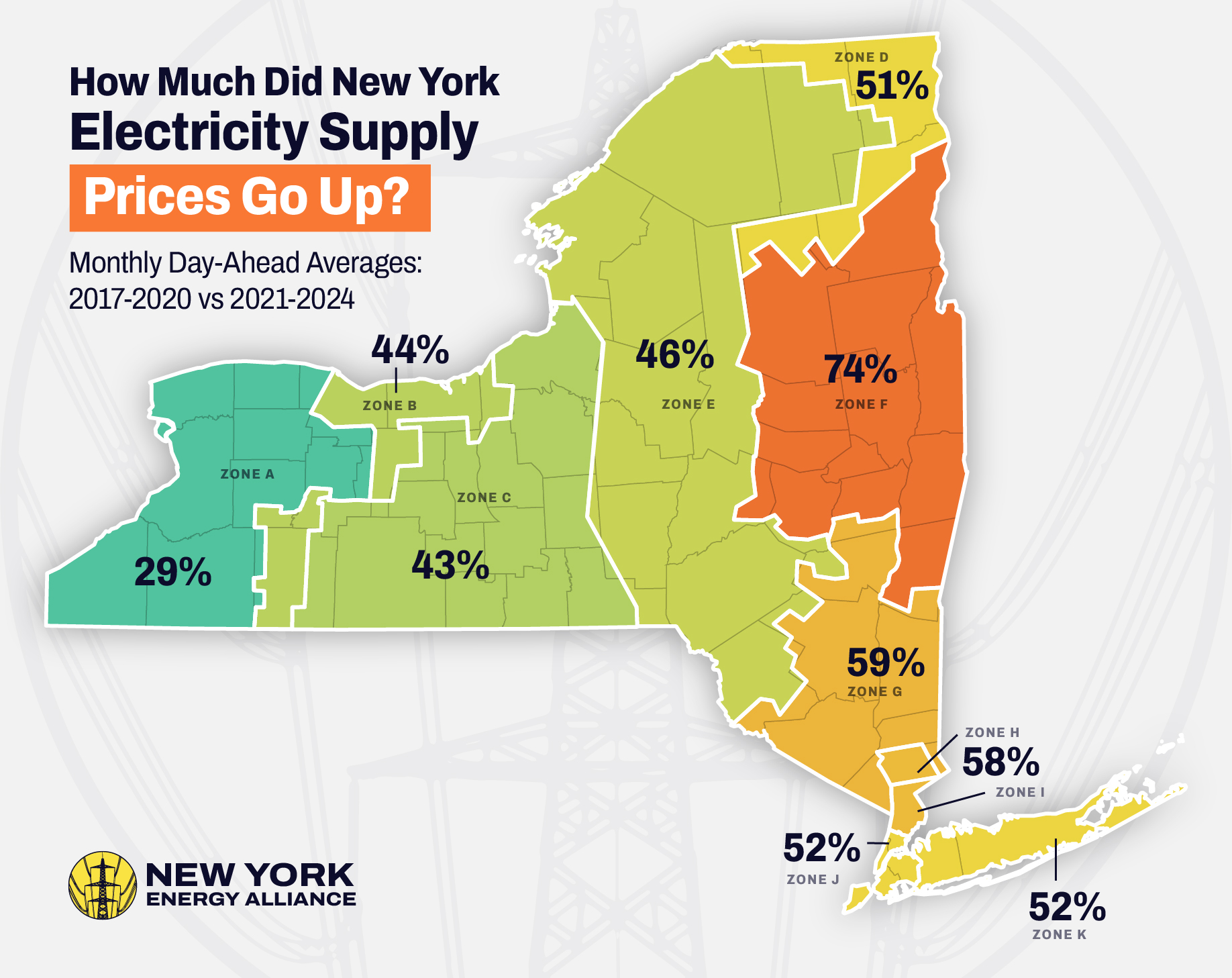
1. Average electricity costs went up anywhere from 29 to 74%

Based on monthly “day-ahead” averages compared from 2017-2020 to 2021-2024, every region saw significant increases in costs The average region’s costs went up by 51% (not weighted for population).

Zone A (West): 29%
Zone B (Genesee): 44%
Zone C (Central): 43%
Zone D (North): 51%
Zone E (Mohawk Valley): 46%
Zone F (Capital Region): 74%
Zone G (Hudson Valley): 59%
Zone H (Millwood): 58%
Zone I (Dunwoodie): 58%
Zone J (NYC): 52%
Zone K (Long Island): 52%

2. The Capital Region and Hudson Valley Increased the Most

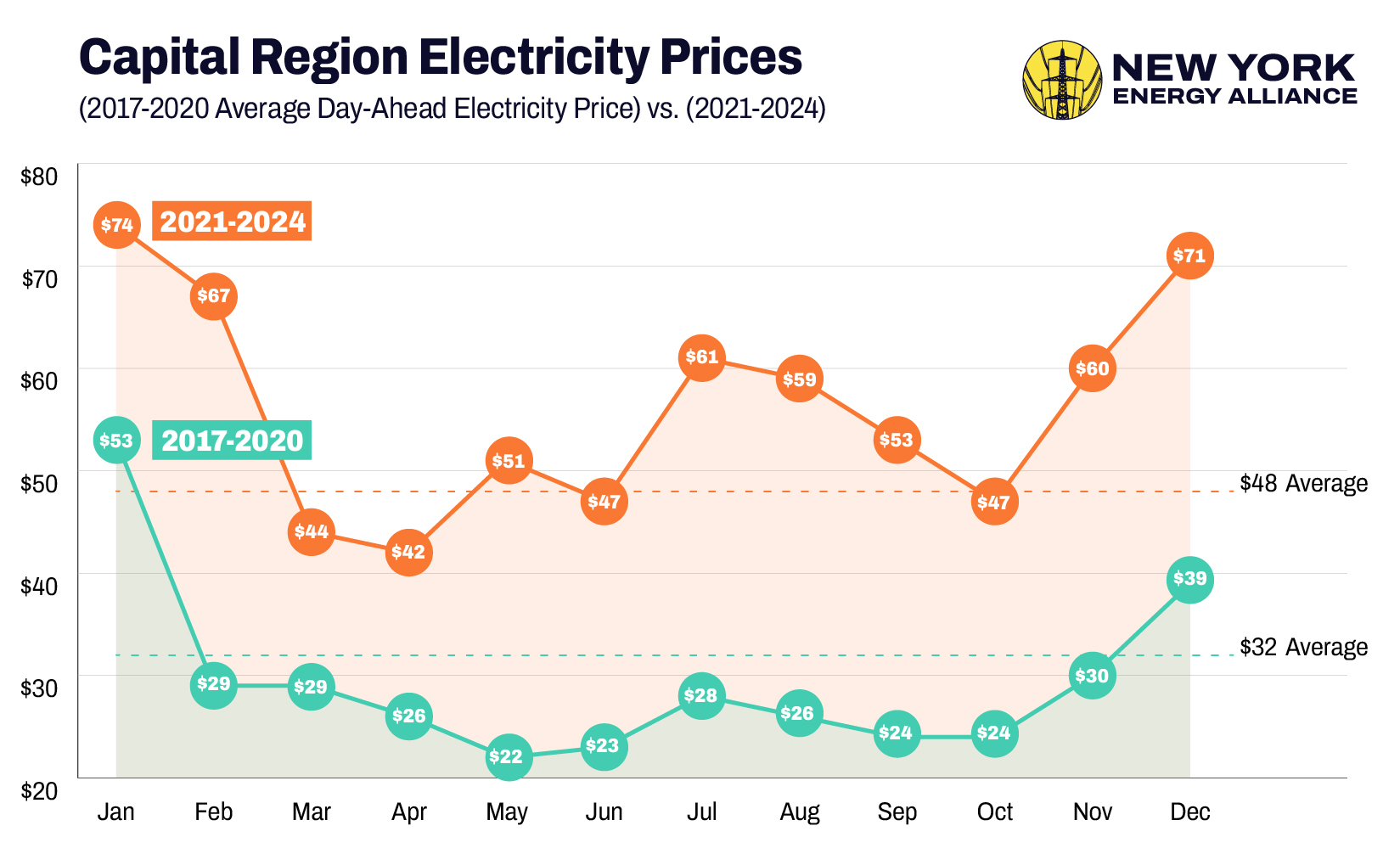
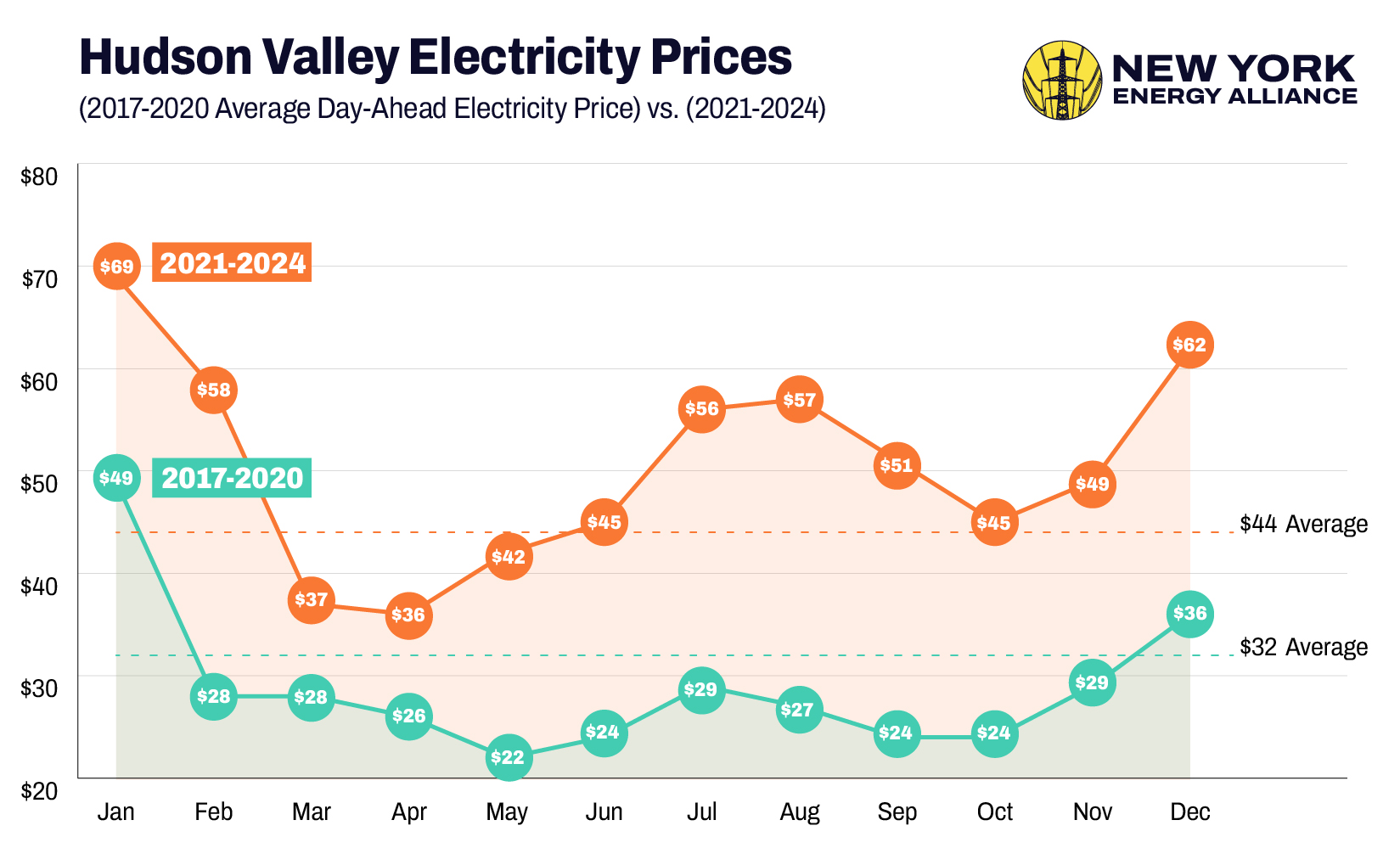
The Capital Region is where the climate laws like the CLCPA were passed, and the Hudson Valley, the birthplace of the environmental movement, is where the laws were largely drafted and lobbied for. Tragically, ratepayers in their NYISO regions were hit hardest by the changes in New York’s electricity markets.

Capital Region (2017-2020 Average Day-Ahead Electricity Price) vs. (2021-2024)Hudson Valley (2017-2020 Average Day-Ahead Electricity Price) vs. (2021-2024)
January$53 —> $74 $49—> $69
February$29 —> $67$28 —> $58
March$29 —> $44$28 —> $37
April$26 —> $42$26 —> $36
May$22 —> $51$22 —> $42
June$23 —> $47$24 —> $45
July$28 —> $61$29 —> $56
August$26 —> $59$27 —> $57
September$24 —> $53$24 —> $51
October$24 —> $47$24 —> $45
November$30 —> $60$29 —> $49
December$39 —> $71$36 —> $62
Average$32 —> $48$32 —> $44

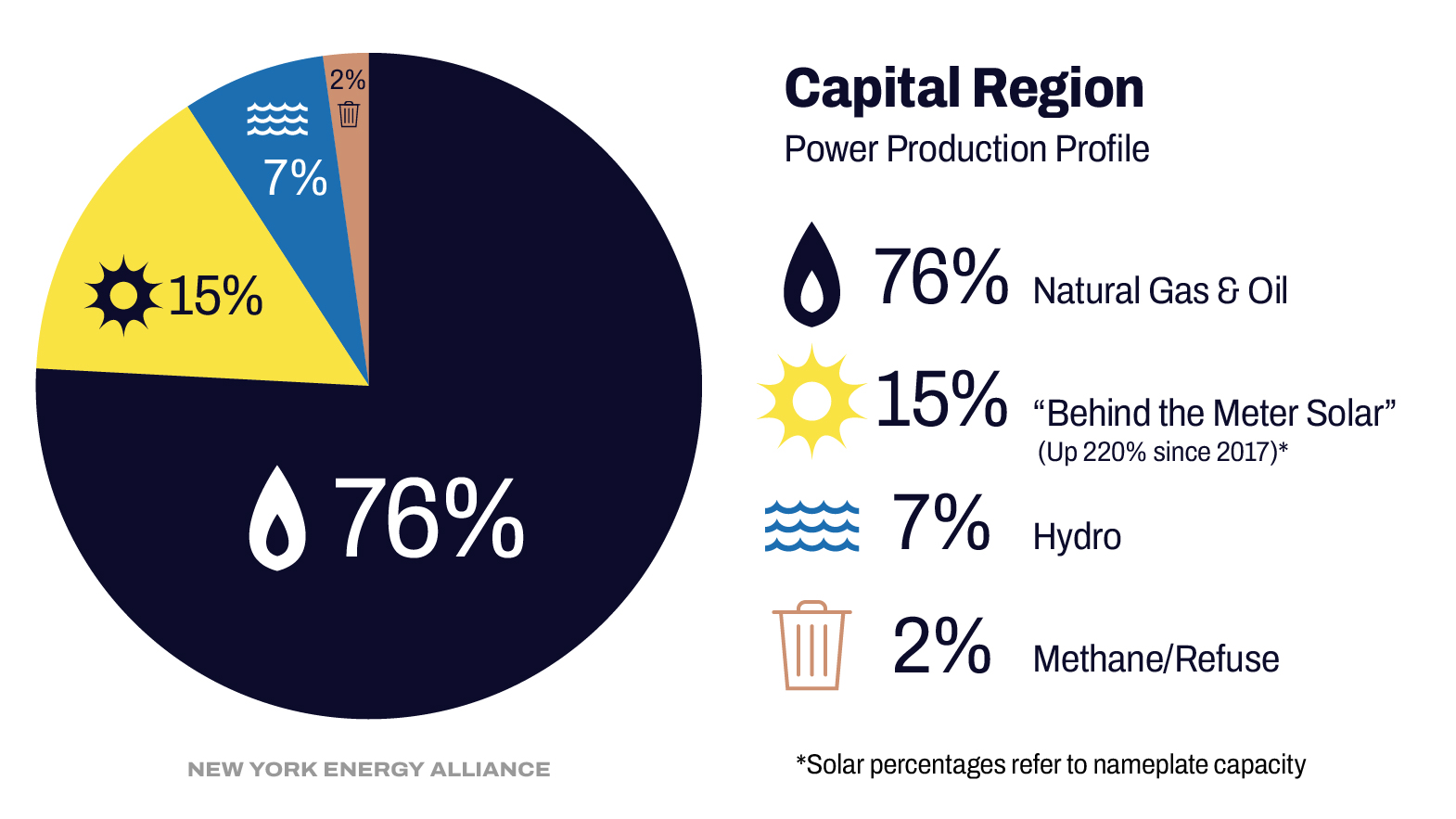
While the entire state was subject to market and geopolitical forces beyond its control, certain attributes of each region’s power grid either inoculated it or made price shocks more extreme. For the Capital Region and Hudson Valley, it was the rapid adoption of rooftop “behind the meter” solar, combined with total reliance on natural gas without hydroelectric production or nuclear power that did them in.

Capital Region Power Production Profile:

76% Natural Gas & Oil
15% “Behind the Meter Solar” (Up 220% since 2017)*
7% Hydro
2% Methane/Refuse

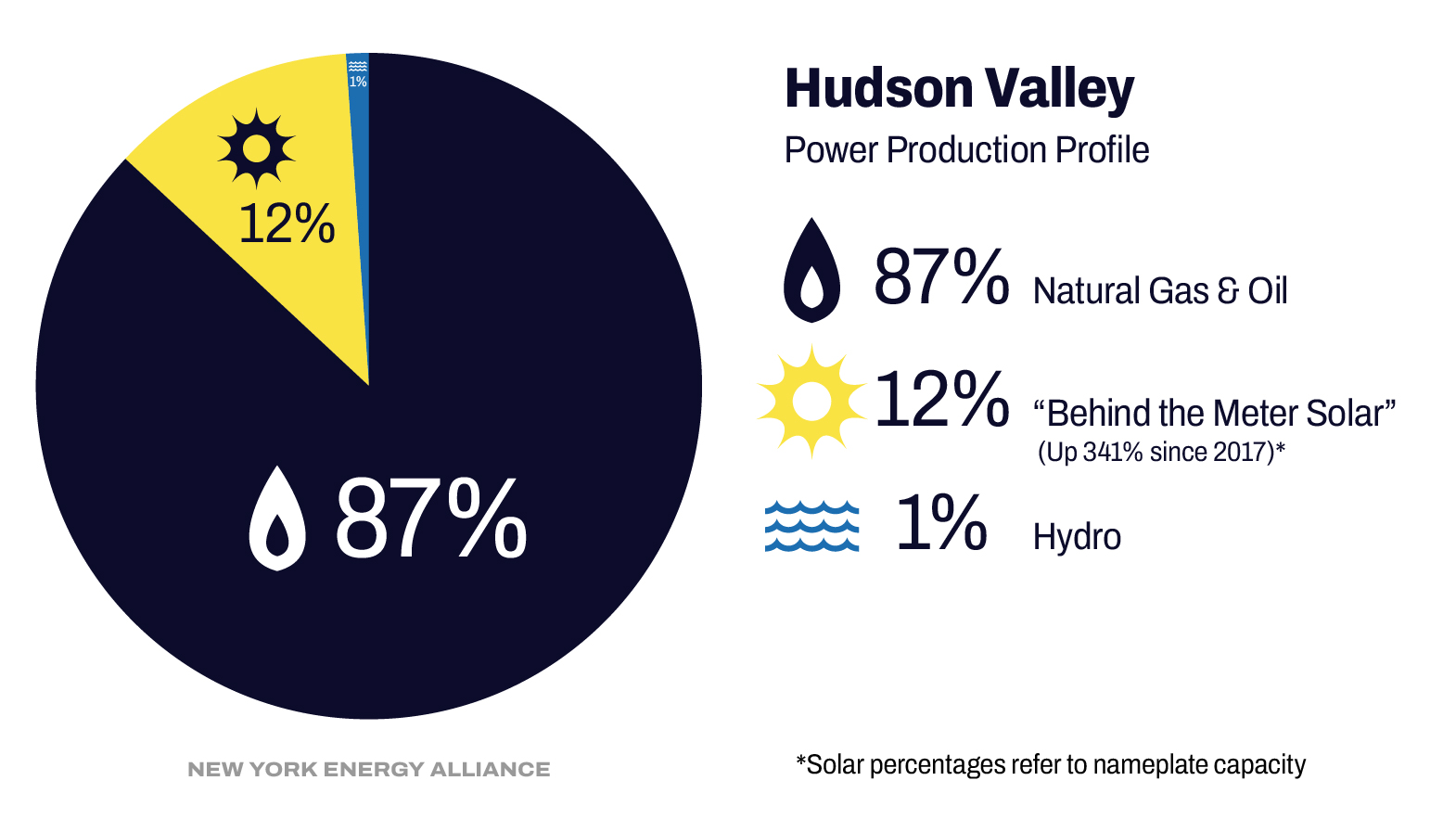
Hudson Valley Region Power Production Profile:

87% Natural Gas & Oil
12% “Behind the Meter Solar” (Up 341% since 2017)*
1% Hydro

* Solar percentages refer to nameplate capacity

3. Western and Central NY’s Nuclear & Hydro Outperformed Upstate’s Gas & Solar

While the Hudson Valley and Albany’s green activists got the headlines and protest footage in the name of building solar panels and shutting down nuclear plants like Indian Point, it was the humble people of Western NY that got to enjoy cheaper power that also happens to be carbonless.

The Moses Niagara hydro plant, as well as three nuclear plants near Oswego and Rochester carried the load to help Zone A (29% increase) and Zone B (44% increase) and Zone C (43% increase) have significantly lower increases than the Capital Region (74% increase) and the Hudson Valley (58% increase). As you can see, Zones A, B and C also were able to affordably accommodate rapid buildouts in intermittent renewables thanks to the baseload provided by hydro and nuclear.

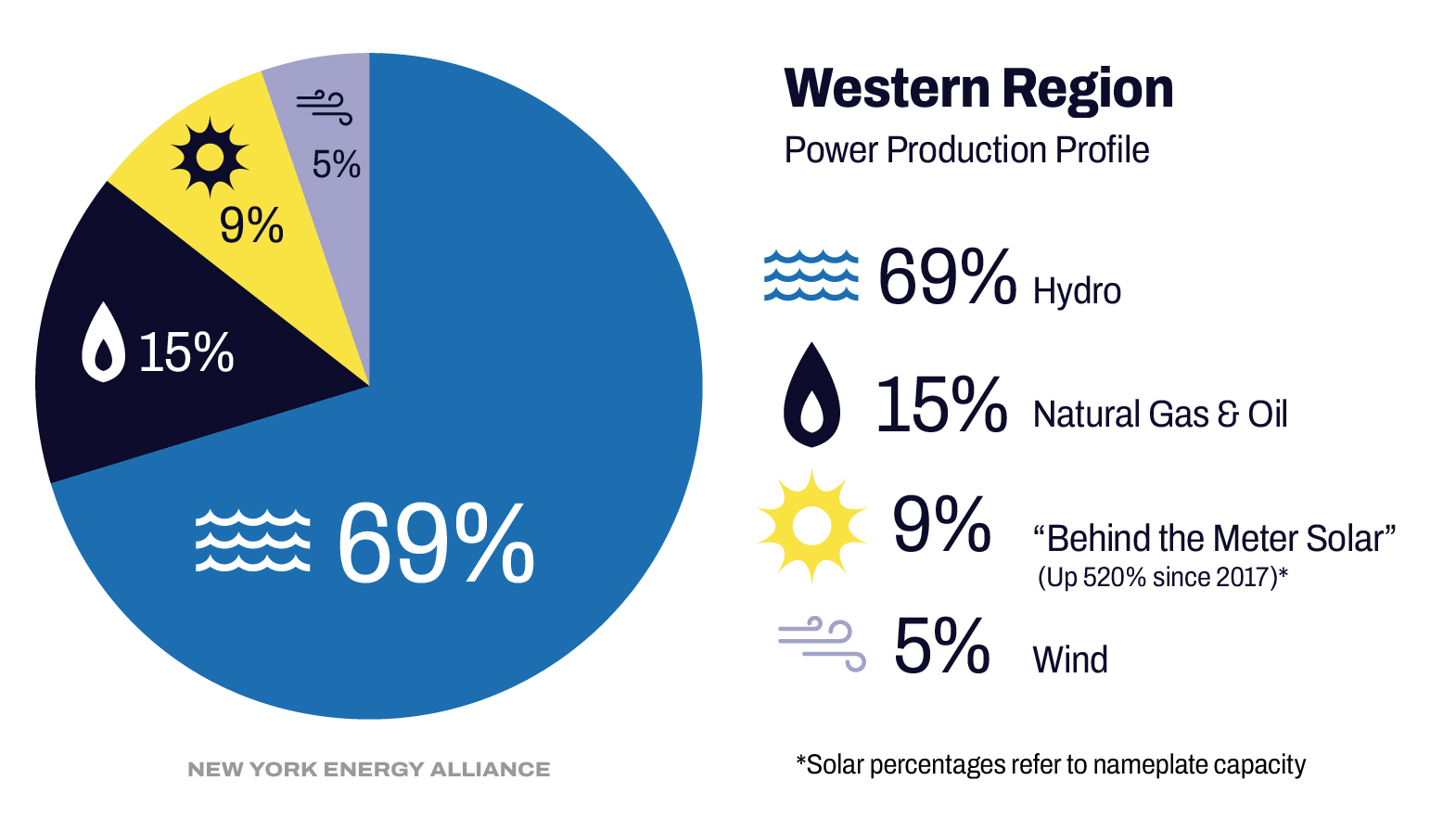
Western Region Power Production Profile:

69% Hydro
15% Gas & Oil
9% “Behind the Meter Solar” (Up 520% since 2017)*
5% Wind

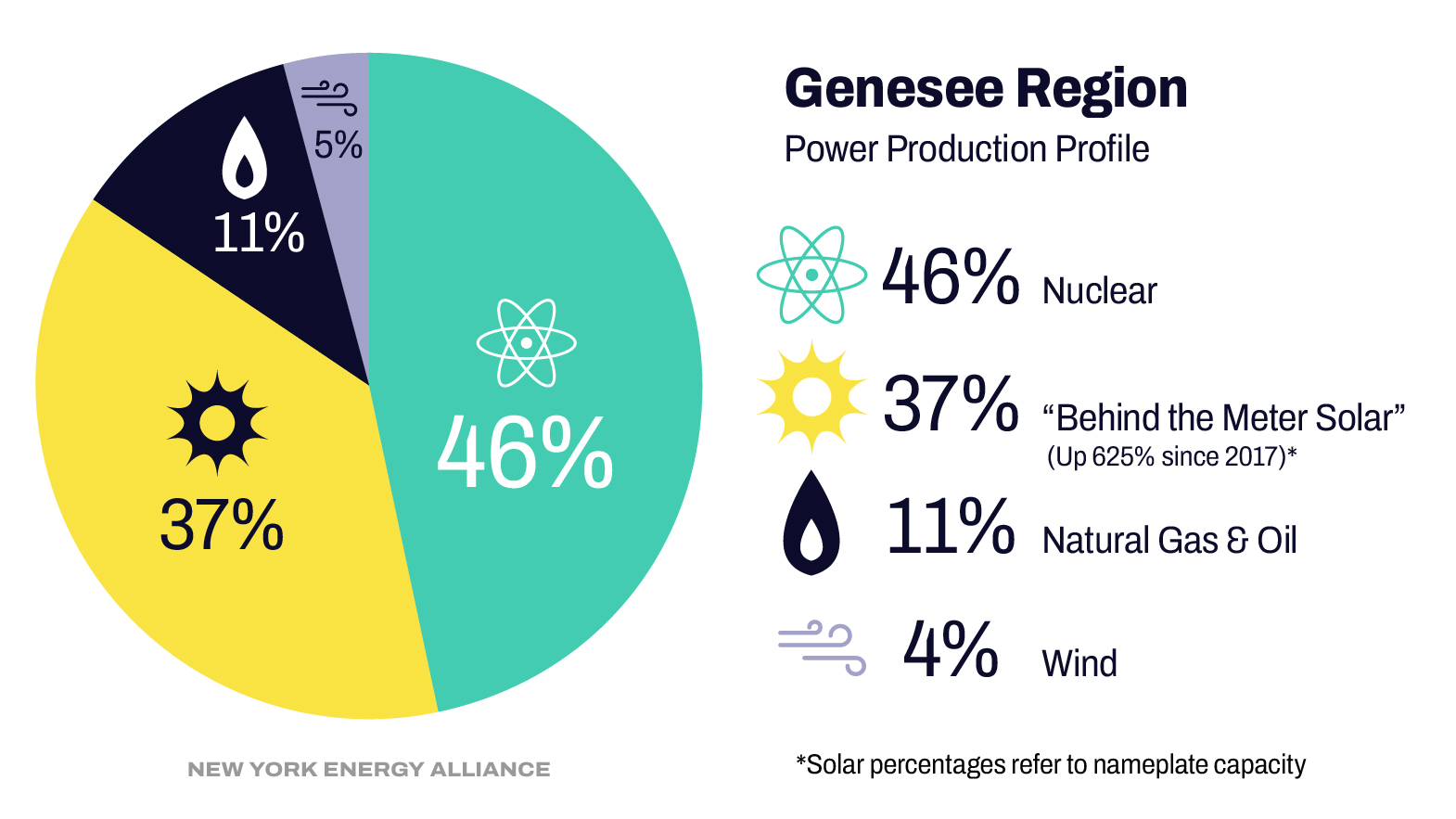
Genesee Region Power Production Profile:

46% Nuclear
37% Solar (Up 652% since 2017)*
11% Gas & Oil
4% Wind

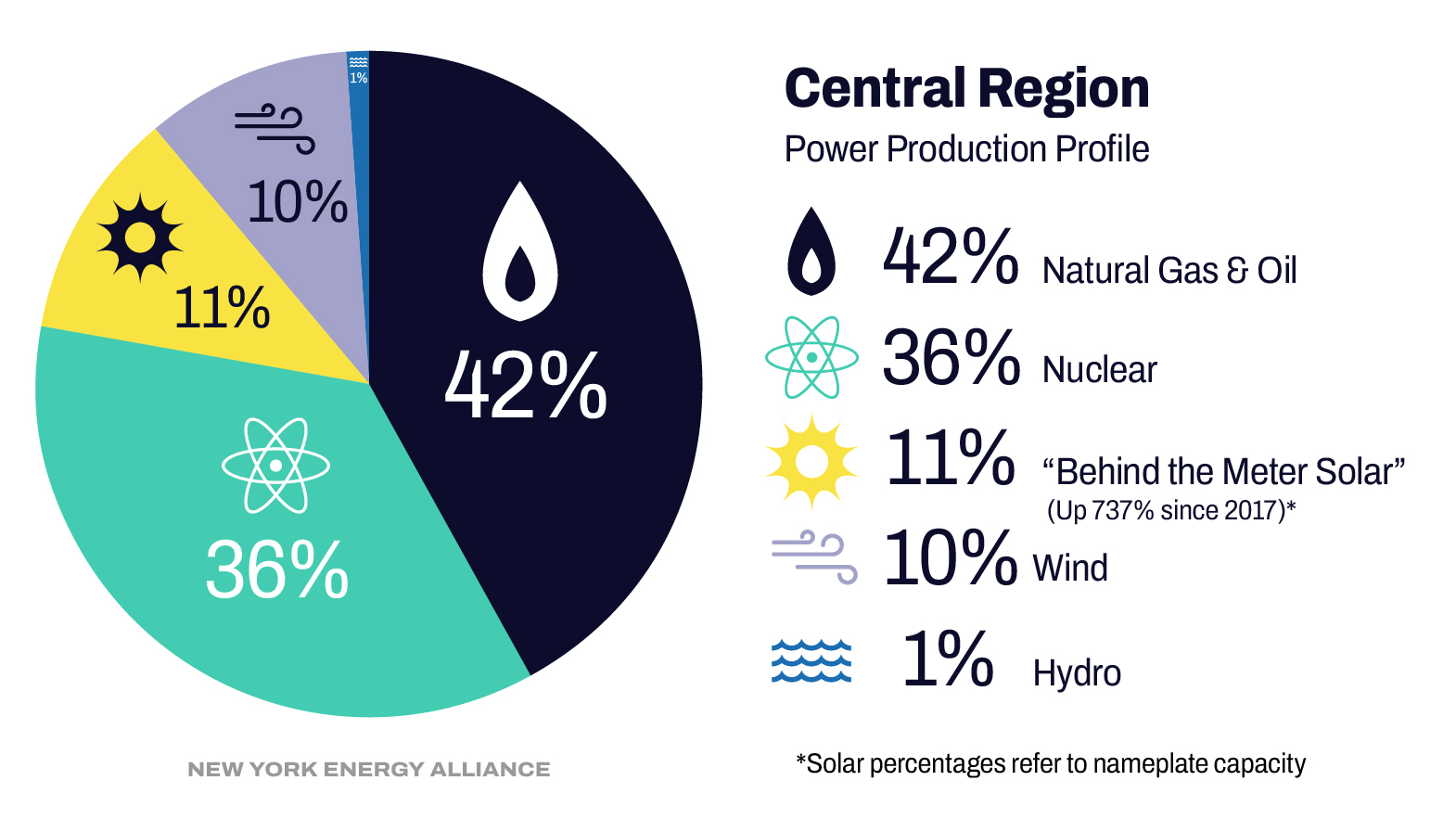
Central Region Power Production Profile:

42% Oil & Gas
36% Nuclear
11% Solar* (Up 737% since 2017)*
10% Wind
1% Hydro

* Solar percentages refer to nameplate capacity

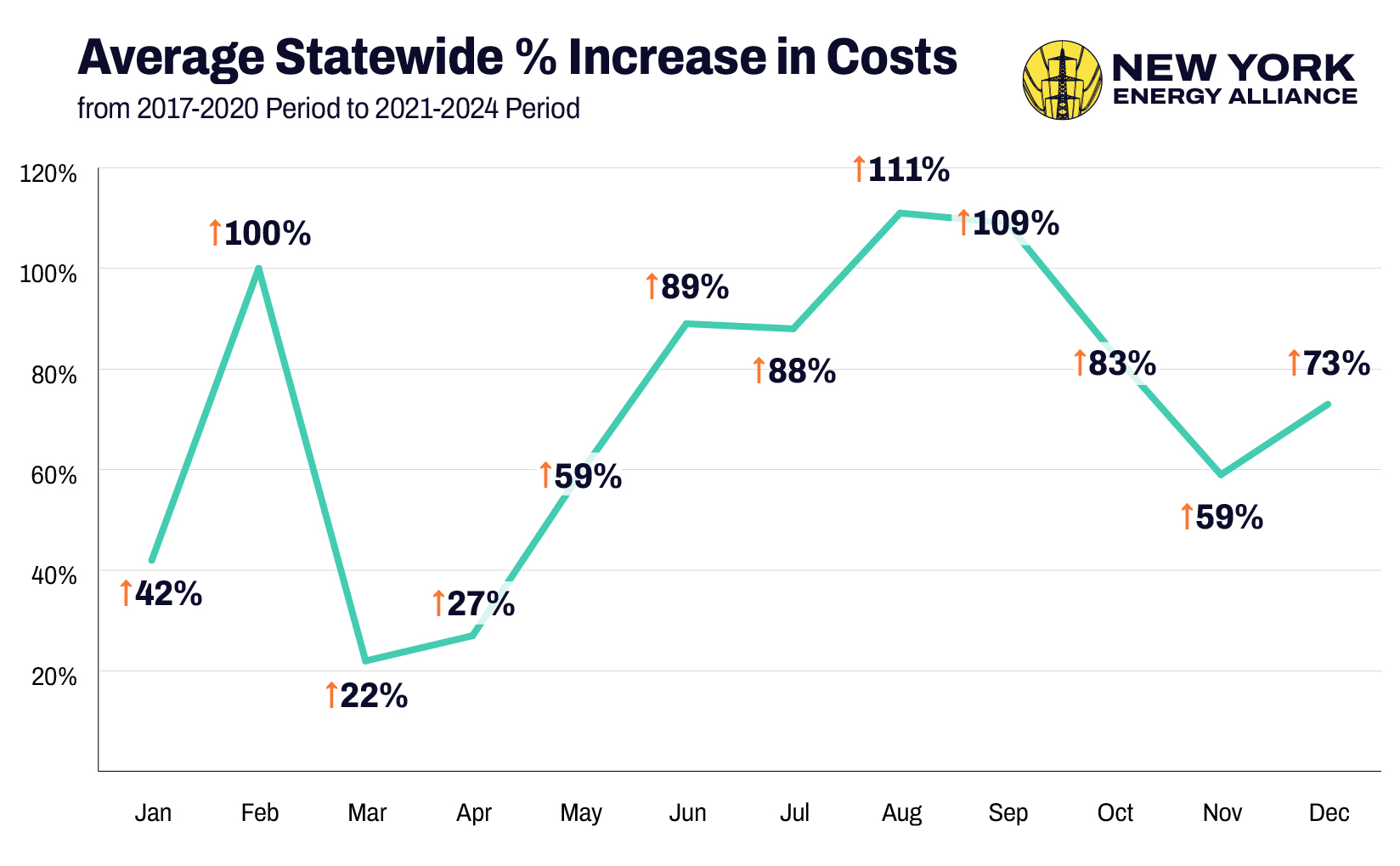
4. Costs Increased Most in the Winter and Summer

When comparing the 2017-2020 period to the 2021-2024 period, the only brief respite in brutal price increases is in March and April, where unusually mild winters have helped ease the burden on New York electricity consumers.

MonthAverage Statewide % Increase in Costs from 2017-2020 Period to 2021-2024 Period
January42%
February100%
March22%
April27%
May59%
June89%
July88%
August111%
September109%
October83%
November59%
December73%

Conclusion

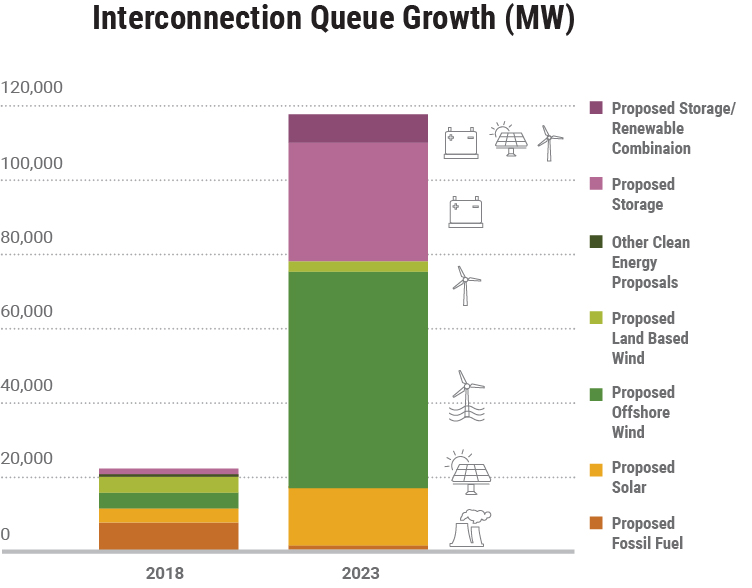
The trends in this article are set to continue for the foreseeable future. The roster of upcoming additions to New York’s energy grid are fully saturated with intermittent renewable energy that increases the day-to-day variability of the grid and electricity prices:

Environmentalists and solar energy lobbyists of Albany remain convinced that New York just needs to ignore the massive increases in consumer prices and keep overbuilding solar and wind.

But it’s time for Albany to admit that it has a problem. Only a rational energy policy that considers consumer costs, reliability, land use AND emission reductions in a holistic manner will help New York thrive again.